Roadside assistance in Wake County over the holidays comes down to one decision you make before leaving the driveway: who you’re going to call, and what you’ll tell them. From the Wednesday before Thanksgiving (November 26 this year) through the drive home after New Year’s, more cars are on I-40, US-1 and NC-540 than at any other time, and every one of them is loaded, running in the dark, and far from the shop that knows it.
We’ve already published the ten-minute check for Thanksgiving week and the December breakdown guide. This is the rest of the plan: what roadside assistance covers, who to call first, what the routes out of the county are like when you’re stopped, and what a loaded car means for the tow. WTF Towing runs 24 hours a day through every holiday, with towing in Cary, NC as home turf.
What “roadside assistance” actually covers
Roadside assistance is a short list of fixes that get a car moving where it sits, plus a tow when none of them will. A jump start is for a car that clicks or cranks slowly; the driver also checks that the alternator is charging. A lockout is keys in the car or a dead fob at a rest stop. A tire change puts your spare on; no spare means a tow. Fuel delivery brings enough gas or diesel to reach a station. A winch-out pulls a car off a soft shoulder or out of a ditch in Apex.
What it does not do is fix a blown head gasket, a slipping transmission or a snapped belt on the side of I-40. Those are a tow — home, to the shop of your choice, or to a safe lot until the shop reopens.
Who to call first: your roadside plan, or a local truck
Most Wake County drivers have a roadside plan they’ve never used — through their auto insurance, a newer car’s plan, or a credit card benefit. Before the trip, find the real phone number and the limits: how many miles of towing it includes, whether it covers winch-outs, and whether it reimburses a receipt if you pay a local company directly. The shoulder of US-1 in the dark is no place to read the fine print.
When you call a plan, you’re talking to a dispatcher who then finds a truck. When you call a local company, you’re talking to the people who own the truck. The difference shows on a holiday weekend, when the only question that matters is “when, exactly?” Save both numbers. Ours is (919) 230-4498 — a person answers around the clock, and the price is quoted before the truck rolls.
The routes out of Wake County, and what each is like when you’re stopped
I-40 is the spine of the holiday: eastbound past Garner to I-95 at Benson and on to Wilmington, westbound past RTP toward Durham and Greensboro, where I-85 continues to Charlotte. Between the RDU exits and the I-40/I-440 split, a stall in a lane turns dangerous fast. Aim for the right shoulder; the left one is narrow, with traffic passing at speed on both sides. Our I-40 and I-440 checklist covers the first five minutes.
US-1 is the road south through Cary, past the US-64 split at Apex, toward Sanford and the Sandhills. If the car is still moving when trouble starts, the exits give you somewhere to get off: Exit 101 for Buck Jones Road, Walnut Street and Crossroads Boulevard; Exit 99 for Cary Parkway; Exit 98A for Tryon Road; Exit 98 for the US-64 split toward Apex. Broke down on US-1 in Cary walks that road exit by exit.
US-64 runs west through Apex past Jordan Lake toward Pittsboro, and east through Knightdale toward the Outer Banks. The Cary-to-Apex section is a freeway with real shoulders; farther out it’s a divided highway with crossovers and fewer safe places to stage a truck.
NC-540 and I-540 make the loop: NC-540, the Triangle Expressway, is the tolled part around Cary, Apex and Holly Springs; I-540 is the free part across north Raleigh from RDU toward Knightdale. Neither has a gas station on it, so a quarter tank at the on-ramp is a decision. The shoulders are good and the lighting is not, so pin your location early. I-440, the Beltline, is short with frequent exits, so if you can limp to one, do; the I-40/I-440/US-1/US-64 interchange on the Cary line is the one place not to stop unless the car gives you no choice.
RDU has its own breakdown, a week after the trip starts: a car left in a ParkRDU lot for seven cold nights with a marginal battery comes back to a family with luggage and no start. Call from the gate and we’ll time the truck to your arrival. RDU Airport towing has the details.
A loaded car changes the tow
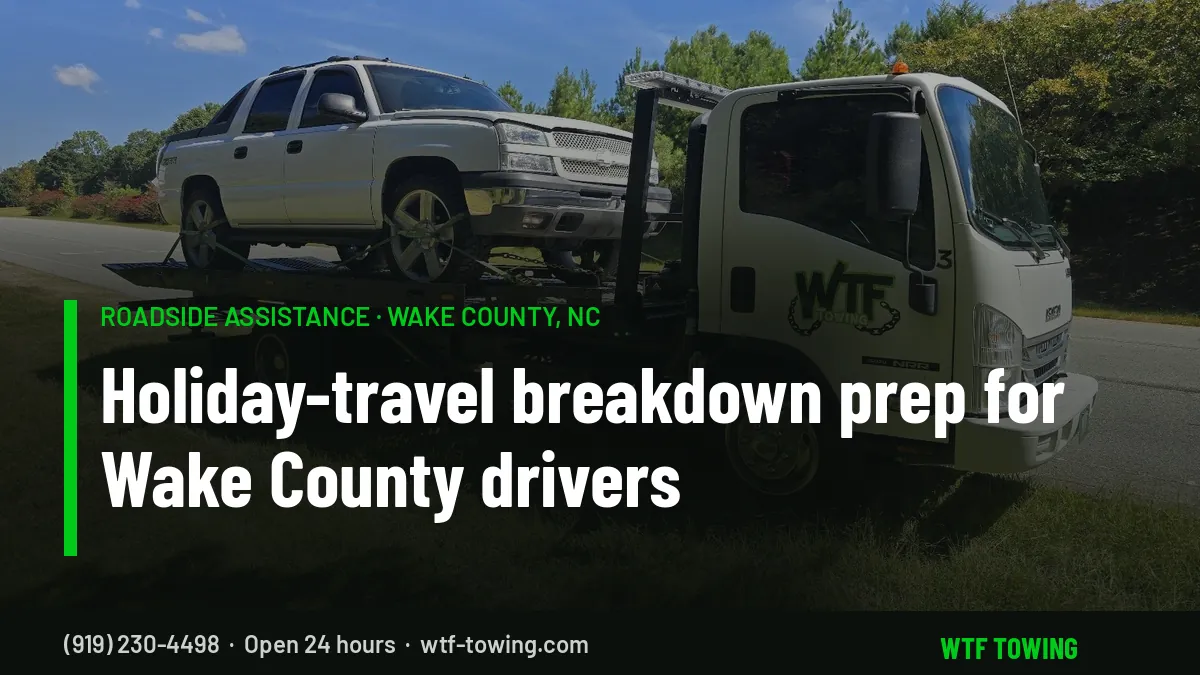
Drivetrain decides the truck. A front-wheel-drive sedan or minivan can ride on the Ram 5500 wrecker’s Jerr-Dan wheel-lift, front wheels up and rear wheels rolling. All-wheel-drive and four-wheel-drive SUVs, electric vehicles and anything low enough to scrape go on one of the two Isuzu NRR rollbacks with 21-foot Jerr-Dan beds, all four wheels off the ground and strapped at four points.
Load decides the plan. The driver will ask what’s on the roof, whether there’s a bike rack or a trailer, and how heavily the car is loaded, because that changes how it’s winched onto the bed and strapped. The truck has a limited number of seats, so tell us how many people are in the car and whether there’s a pet. Gifts and valuables go with you, not with the car.
Far from home is still our job. If the car quits at a rest stop on the way to the coast or outside a relative’s house in Charlotte, long-distance towing on the rollback brings it back to Cary on one upfront quote.
The holiday mistakes we see every year
- Driving the spare to the beach. A temporary spare has speed and distance limits printed on its sidewall, well below I-40 speed and well short of Wilmington. Fix the real tire at the first tire shop, or ride the rollback.
- Standing behind the car. On an interstate shoulder, stay belted in with the hazards on, or get well off the road beyond the guardrail — never between the car and traffic.
- “Somewhere on I-40.” Direction of travel, the last exit, a mile marker or a dropped pin gets a truck to you. “Near Cary” covers twenty miles of interstate.
- Taking the first truck that shows up. If you didn’t call it and nobody will name a price and a destination before hooking up, you can say no. On a non-police tow, the choice of company is yours.
What it costs: the factors, not the dollars
The factors are the same for everyone: distance (where the car is and where it’s going), which truck comes (a wheel-lift tow and a rollback tow are different jobs), the vehicle (a loaded AWD SUV takes more care than an empty compact), the situation on scene (a lane on I-40 versus a lot, a winch-out first, a parking deck), and whether the drop-off is open when you get there. Holidays and nights don’t add a surcharge. Our pricing post goes through each factor; one call gets you one number before the truck moves.
If it happens anyway: what to do, in order
- Get right. While the car still has momentum, signal and move to the right shoulder, an exit ramp or a lot. Hazards on the moment something feels wrong.
- Decide where to be. On a highway, stay belted in unless you can get well clear of traffic. In a lot or a neighborhood, you have time.
- Pin your location. Direction, last exit, mile marker, and a dropped pin. Plug the phone into the car if it still has power.
- Describe symptoms, not a diagnosis. “It cranked slowly, then clicked” tells the dispatcher which truck and which fix.
- Say what’s in the car. Drivetrain, roof load, trailer, how many people, any pet.
- Pick the destination. Home, the shop of your choice, or a safe lot until the shop reopens.
- Call once, then stay put. Give a callback number, keep the line free, and don’t walk the shoulder looking for a better signal.
Common questions
Do you cover all of Wake County?
We’re based in Morrisville and run Cary, Morrisville, Apex, Holly Springs, New Hill, RTP and RDU every day, with regular jobs into Raleigh and Durham. Farther out, call and we’ll tell you straight whether we’re the right truck and when it can be there.
Should I call my insurance roadside plan or you?
Whichever gets a truck to you soonest. Call us directly and you get an upfront quote and a receipt to submit if your plan reimburses — check its rules before the trip. If you use the plan, keep our number for the moment the dispatcher can’t give you a time.
Can you tow my car home from the coast or from Charlotte?
Yes. Long-distance tows run on the rollback with one upfront quote for the whole trip.
Are you open on Thanksgiving, Christmas and New Year’s?
Yes — 24 hours, our own trucks and drivers, same price as any other day. We’re licensed and insured (USDOT 4241594, MC 1642674, $1,000,000 liability), so the car is covered on the hook whether it’s December 25 or a Tuesday in March.
Save the number before you pack the car: (919) 230-4498. When your car makes you say WTF, you call WTF Towing.
