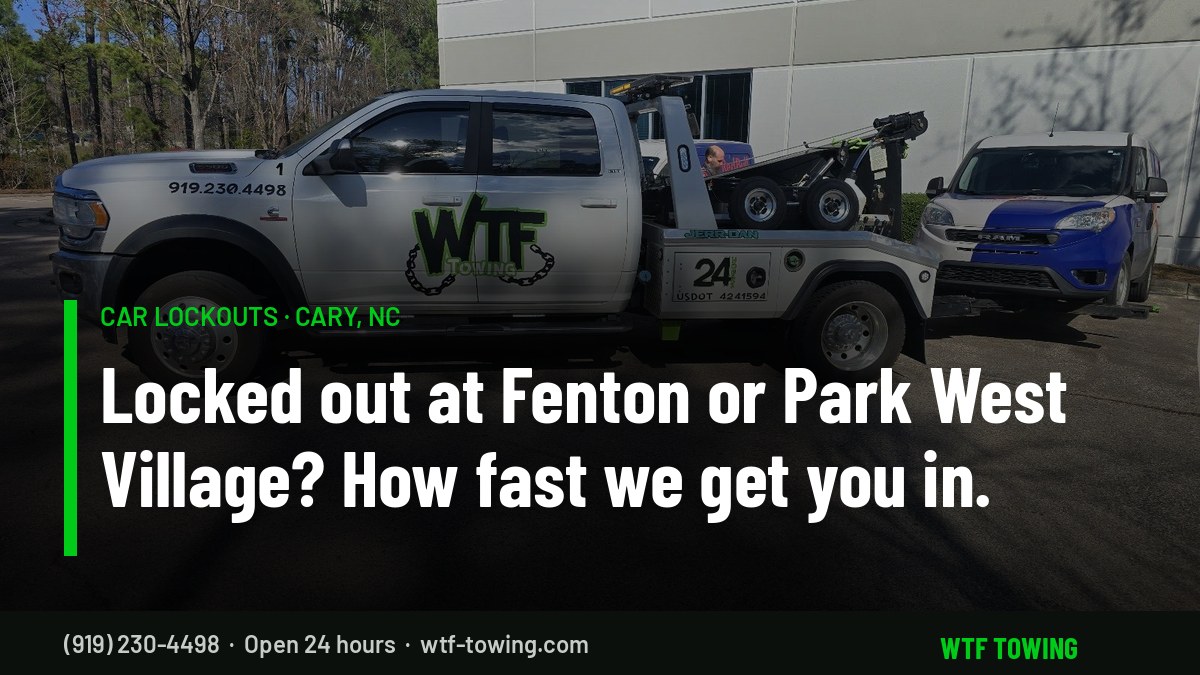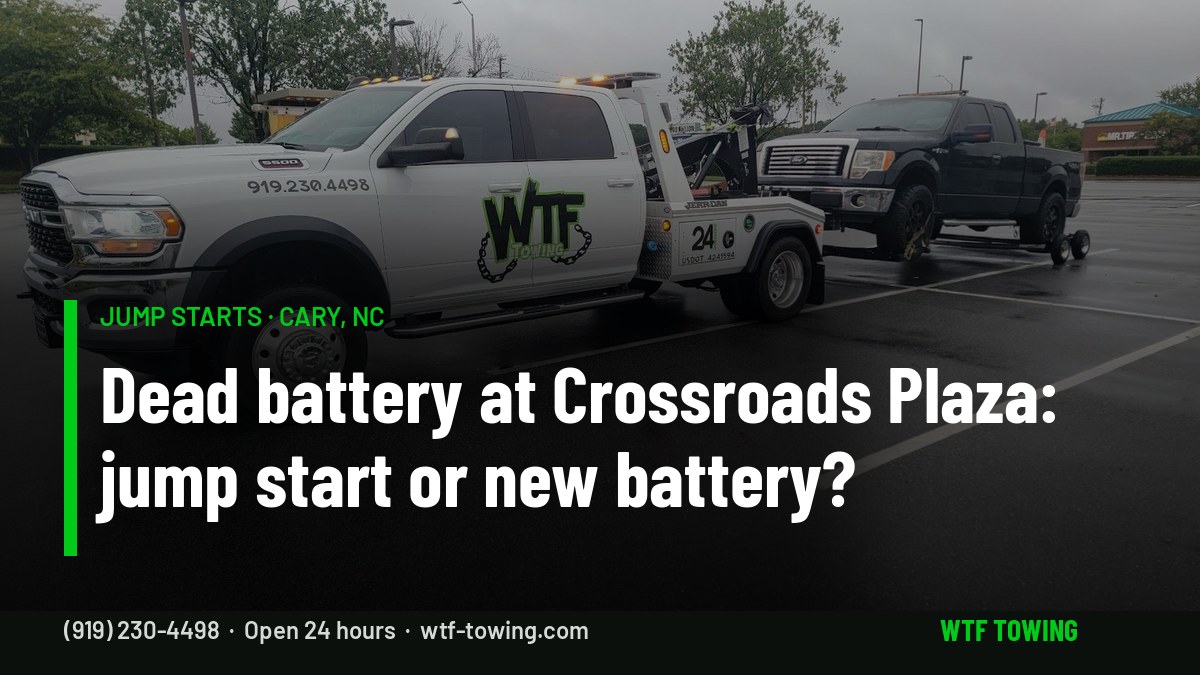
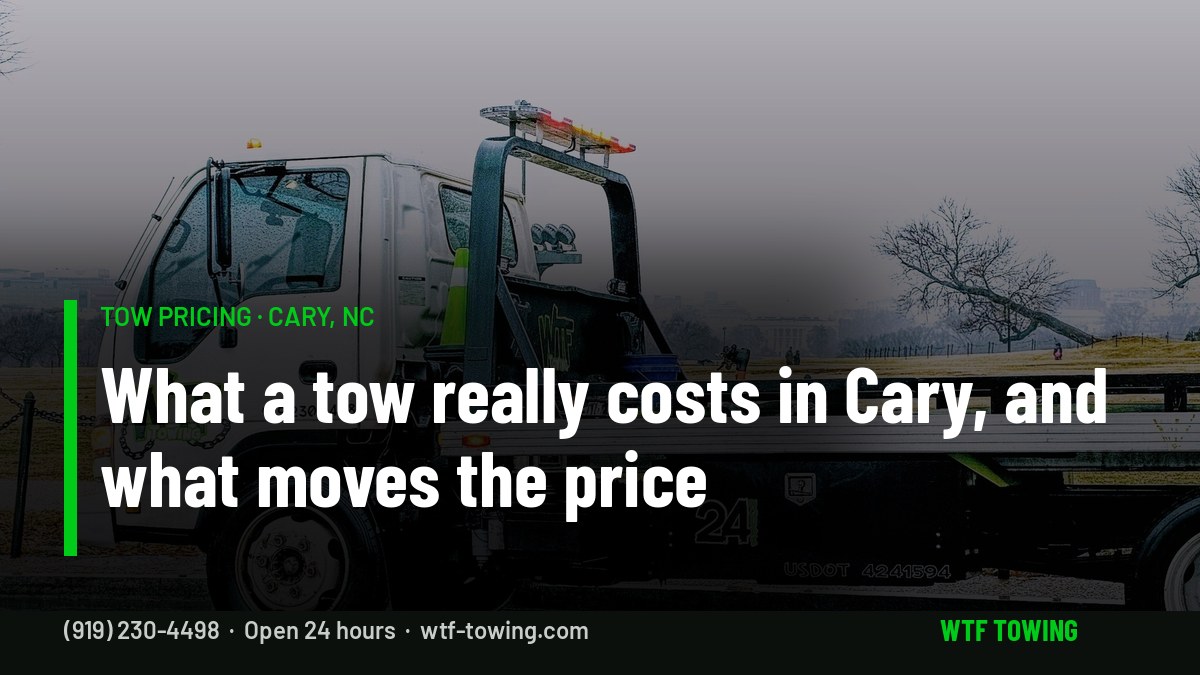
A tow in Cary, NC is priced from a handful of things: how far the truck has to go, which truck the job needs, what you’re driving, and how much work it takes to get the car onto the truck. There is no single number that fits every call, but once you know those factors you can get a straight quote in one phone call.
We don’t publish a price list, and you won’t find dollar figures here, because a wheel-lift tow from Crossroads Plaza to a shop on Chatham Street and a rollback run from an RDU parking lot to a dealer in Durham are different jobs. Here is what moves the price. Or skip the reading and call (919) 230-4498 with your location, your vehicle, and where it’s going.
What you’re actually paying for
Most tow bills are built the same way. A hook-up fee, sometimes called a base rate, covers the truck coming out, loading your car, and unloading it at the other end. A mileage charge covers the loaded miles, from where the car sits to where it’s going. Some companies also bill the miles the truck drives to reach you, so ask whether the quote covers both legs. Extras apply only when the job calls for them: winching if the car is off the pavement, dollies if the wheels won’t roll, wait time, and storage if the car has to sit on a lot.
The number that matters is the total for your specific trip, hook-up and mileage together, with any extras the dispatcher can see coming. That’s the quote to ask for, and it’s the one we give.
Not every breakdown is a tow, either. A jump start, a tire change, a lockout, or fuel delivery is priced as a service call, and if it fixes the problem on the spot it’s the cheaper answer.
Distance is the biggest factor
Two distances matter. The first is how far the truck travels to reach you. We’re based in the Morrisville–Cary area, so most of Cary, Morrisville, and the RTP side of town is a short run for us.
The second is where the car is going, and that one you control. From the Walnut Street and Crossroads exit on US-1 (Exit 101) to a shop on Kildaire Farm Road is a short loaded run. From the same spot to a dealer on the far side of Raleigh, or out I-40 past Southpoint and up NC-147 into Durham, is a longer one, and it’s priced that way. Charlotte, Wilmington, and Greensboro are long-distance towing jobs, quoted as a whole trip.
The closest shop is usually the cheapest destination, but only if it can take the car. A shop that’s closed until Monday means the car moves twice and you pay twice. Deciding the destination before you call is the easiest way to keep a tow cheap.
Which truck shows up, and why it changes the number
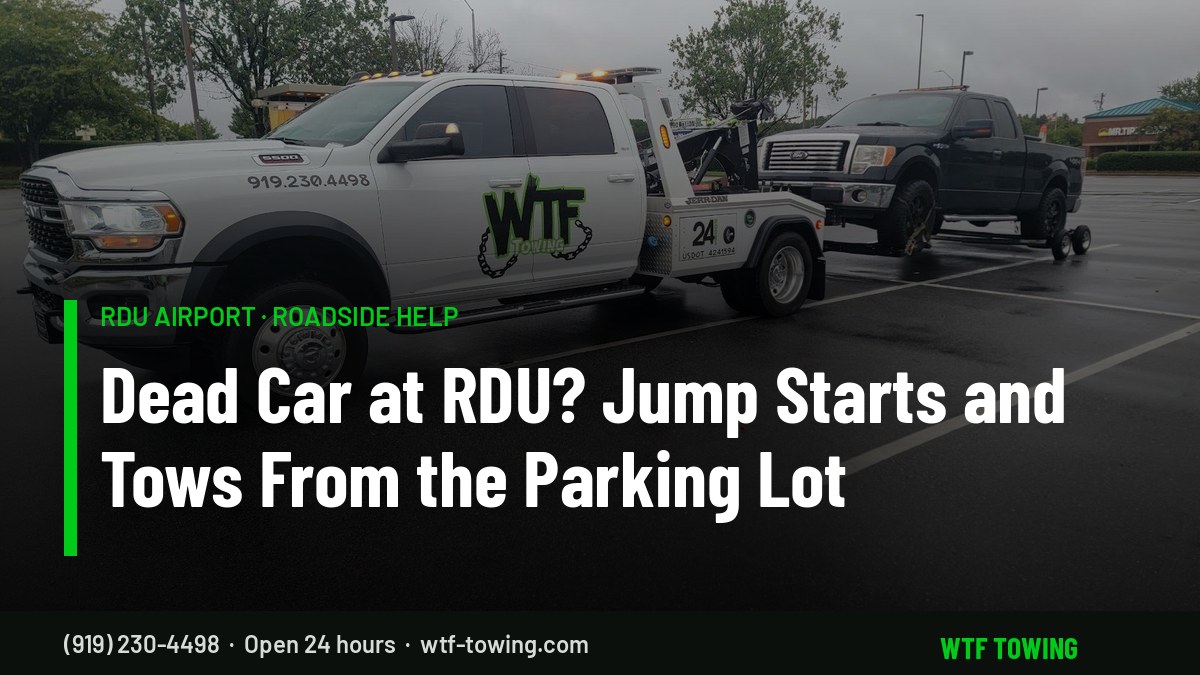
We run a Ram 5500 wrecker with a Jerr-Dan wheel-lift and two Isuzu NRR rollback carriers with 21-foot Jerr-Dan beds. They do different jobs.
The wheel-lift picks up one end of the car and lets the other end roll. It’s quick, and it works in tight spots where a rollback can’t get lined up: a packed lot at Crossroads Plaza, a narrow driveway, the end of a cul-de-sac.
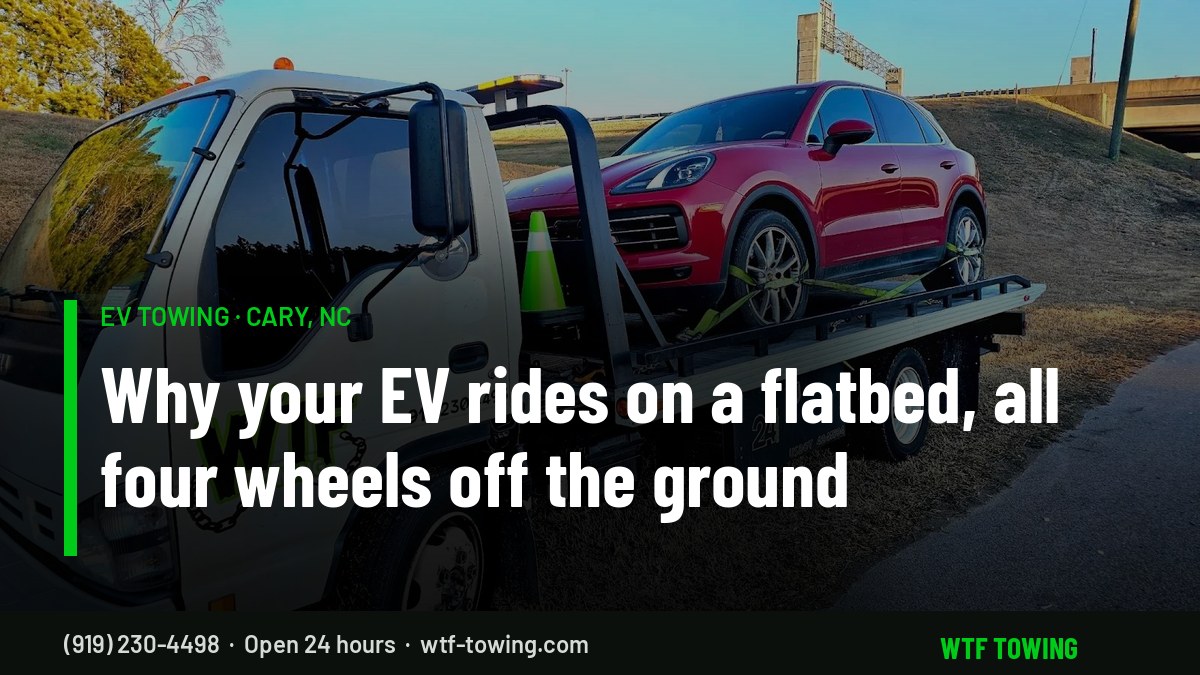
The rollback carries the whole car on the bed. It’s the truck for all-wheel-drive and four-wheel-drive vehicles, EVs, lowered cars, anything with a bent wheel or collapsed suspension, and anything that won’t roll or steer. Dragging an AWD car with two wheels on the ground can damage the drivetrain, and a lowered car can drag its front end once the rear is lifted, so for those vehicles the rollback is the only safe way. Our guide to tow truck types and capacity goes deeper.
Weight matters too: a loaded work van takes longer to secure. But the expensive mistake isn’t the truck type, it’s the wrong truck arriving because nobody mentioned the car was AWD. Give us the year, make, model, and drivetrain and the right truck comes the first time.
The situation on scene: a simple hook-up or a recovery
On an easy call, here’s what the driver actually does: parks the truck in line with your car, sets the wheel-lift or tilts the bed, hooks or straps the car, gets it into position, secures it at four points, and goes. In a lot at Park West Village or a driveway off Davis Drive, that’s a few minutes of work.
What adds time, and cost, is a car that isn’t just sitting on pavement. One that slid off the shoulder of NC-55 into wet grass needs a winch-out before the tow can start; our post on what a Cary winch-out looks like walks through that job. A crash on I-40 or at the US-64 split off US-1 (Exit 98) means wheels turned in, fluids on the road, and law enforcement directing where the car can go, so the driver is working with dollies instead of a clean hook-up. A low-clearance deck, a car locked in park with no keys, a sloped driveway: each one is more rigging and more time. A highway shoulder, like US-1 at Cary Parkway (Exit 99), is its own situation; our post on breaking down on US-1 in Cary covers it.
Time of day comes up too. Some companies add a night, weekend, or holiday charge. We’re open 24 hours, every day; whatever hour you call, ask for the total and you’ll have it before the truck rolls.
Last, storage. If the car can’t go straight to its final stop, say a crash at 2 a.m., it has to sit somewhere, and most towing companies charge storage by the day. Ask where the car will be, what that costs, and when you can get it released.
What your roadside plan changes, and what it doesn’t
Many Cary drivers have roadside coverage through an insurance policy, a credit card, a new-car warranty, or a membership plan. Most plans cover a tow up to a set number of miles or a set dollar amount, and past that limit you pay the difference. Some plans send a truck from their own network and you pay nothing at the curb; others let you call whoever you like and reimburse you afterward. They feel very different at midnight, so read your plan now.
After a crash, the tow is often part of the insurance claim instead, and your insurer may have a preference about where the car goes. Ask before it moves so it doesn’t move twice. Either way, keep the itemized invoice. We give you one on every job.
How to get a straight price from any Cary tow company
This works with any company:
- Know exactly where you are. Road plus the nearest cross street, the US-1 exit number, the store you’re parked in front of, or a dropped pin.
- Know what you’re driving. Year, make, model, and drivetrain. Say if it’s an EV, lowered, or loaded with tools or cargo.
- Say what’s wrong, plainly. Does it start? Roll? Steer? Are the keys with you? Is it on pavement? Was it in a crash?
- Decide where it’s going. Shop name and address, and whether they can take it now. After hours, confirm the shop has a key drop.
- Ask for the total, not the base rate. Hook-up plus mileage to that address, with any extras the dispatcher can see coming.
- Check your roadside plan first if you want to use it. Know the mileage cap and whether it sends its own truck or reimburses you.
- Don’t try to fix it yourself first. Spinning the tires in mud, a stranger’s pull with a strap, or driving on a flat turns a small job into a bigger one.
The common mistakes are the opposite: leaving a car on the shoulder of I-40 or US-1 overnight, where law enforcement can have it removed at your expense; towing to a shop that’s closed; forgetting to mention the car is AWD; and calling for a tow when a jump start or a gallon of gas would have fixed it.
Common questions
Is a flatbed tow more expensive than a wheel-lift tow?
At some companies it is. The better question is which one your car needs. AWD, EVs, lowered cars, and damaged cars need the rollback, and putting them on the wrong truck costs far more than any price difference. Tell us what you’re driving and we’ll tell you which truck is coming and whether it changes your quote.
Why would the price change when the truck arrives?
Because the job on the ground turned out to be different from the one described: the car was in the ditch rather than on the shoulder, the wheels don’t roll, or there’s a second vehicle involved. A good company tells you before doing extra work. Describe the situation accurately and this almost never happens.
Does my roadside plan cover the whole tow?
Up to its limit. Most plans cap the covered miles or dollars, and you pay anything beyond that. Your plan documents have the specifics.
Need a tow in Cary, Apex, Morrisville, or anywhere in the Triangle right now, or just want a number before you commit? Call (919) 230-4498 and you’ll have a quote in one call. Our Cary towing page covers everything we do in town. When your car makes you say WTF, you call WTF Towing.