
Dead battery in Cary? Call (919) 230-4498. WTF Towing jump-starts cars and trucks 24/7 — at home, at work, in the store lot, at RDU, or on the shoulder.
Heat kills batteries faster than cold does, which is why our jump-start calls spike in August and again on the first cold morning in November. A car that cranked slowly last week won’t crank at all this week. The dome light was left on. The car sat in RDU long-term parking for nine days. Whatever the reason, a jump start gets you moving, and we’ll tell you honestly whether the battery is done or just drained.
What our jump-start service includes
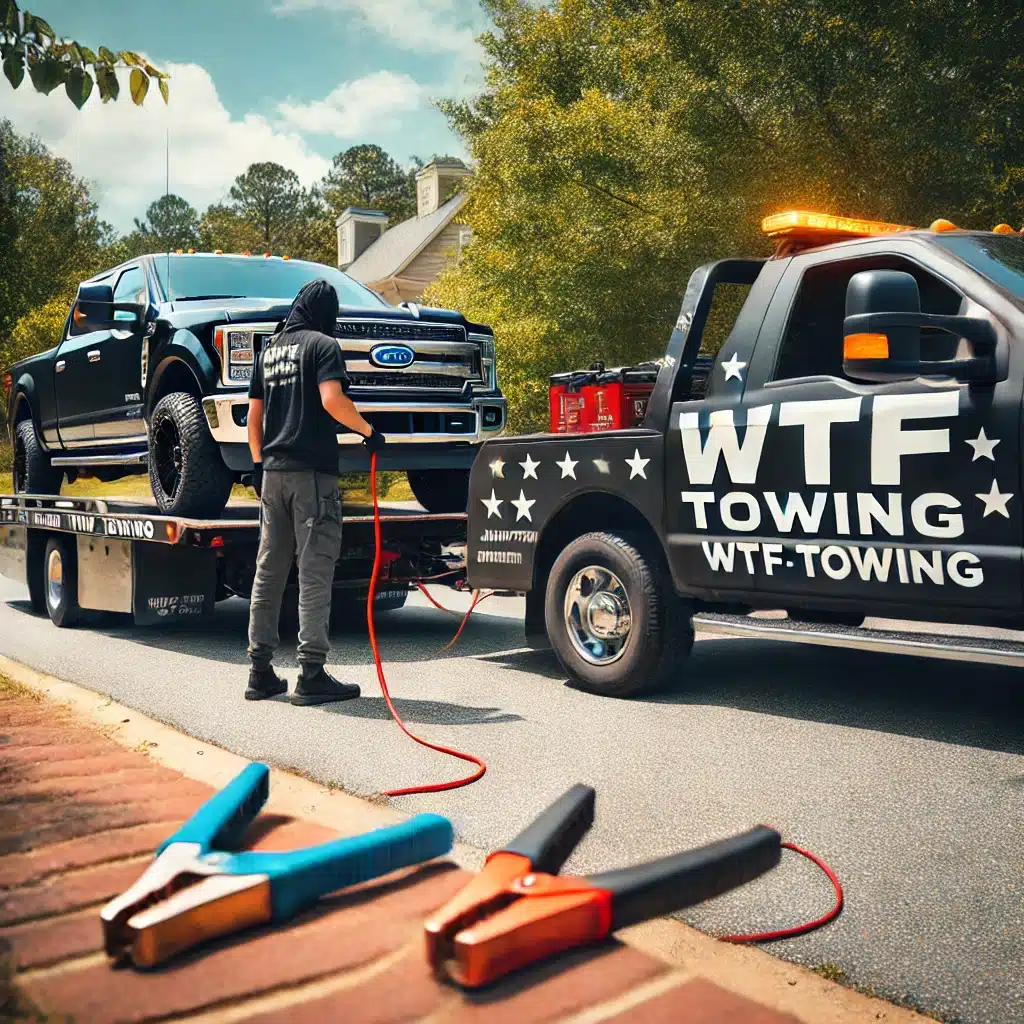
- Safe jump start with professional booster packs — correct polarity, correct procedure, no risk to your vehicle’s electronics.
- A quick read on whether the battery is recovering or needs replacing, so you don’t get stranded again an hour later.
- Hybrid and EV 12-volt systems — most hybrids and EVs still have a 12-volt battery that can strand you even when the main pack is charged. We know where it is and how to boost it.
- A tow if it isn’t the battery — a dead alternator or starter won’t jump. Same truck, same call, we take you to a shop.
Is it the battery, the alternator or the starter?
Rapid clicking or nothing at all when you turn the key usually means battery. Car starts with a jump but dies again in a few minutes means alternator. A single loud click and no crank often means starter. You don’t have to diagnose it — call us, describe what it’s doing, and we’ll bring the right plan.
How it works
- Call (919) 230-4498 with your location and what the car does when you try to start it.
- We quote the price upfront and give you a real ETA.
- The driver connects the booster, starts the vehicle, and checks the charging system.
- You drive on — with a straight answer about whether to head to an auto parts store today.
Where we do jump starts
Driveways and garages across Cary, Apex, Morrisville and Holly Springs; office parks in RTP and Weston; the lots at Crossroads Plaza, Fenton, Park West Village and Waverly Place; every ParkRDU lot and the hotel lots along Aviation Parkway; and highway shoulders on I-40, NC-540, US-1 and US-64.
A note on jumper cables
A stranger’s cables in a parking lot can fry a modern car’s electronics if the connection order is wrong, and a lot of cables sold today are too thin to start a truck. If you’re not sure, don’t. A professional jump is cheap insurance.
Why batteries die in Cary, and when
Our jump-start calls come in three waves. The first is late summer: weeks of 95-degree afternoons cook the battery in the engine bay, and by the end of August a four-year-old battery has lost a big share of its capacity without any warning. The second is the first cold snap in November or December, when thick oil and a 35-degree morning ask the battery for everything it has left. The third is year-round and quieter: short trips. A car that only does the school run and the grocery run never drives long enough to put back the charge it used to start, and after a few weeks it’s flat. Add a trunk light that never turned off, a dashcam wired to constant power, or a car that sat in ParkRDU for ten days, and you have the rest of our calls.
The warning signs are slow cranking, headlights that dim when you start the car, a dash that flickers, and a battery more than four years old. If yours does any of those, get it tested before it picks the morning of a flight to quit.
What the driver actually does
He starts by asking what the car did when you turned the key, because that tells him whether it’s worth jumping at all. Then he puts a meter on the battery: a healthy resting battery reads around 12.6 volts, and one below 12 volts is deeply discharged. He connects a professional booster pack, positive first, negative to a ground point rather than the battery post, and starts the car. With it running he reads the charging voltage — a working alternator holds around 13.5 to 14.5 volts. If it does, the battery is probably recoverable and you can drive. If it reads low, the alternator isn’t charging and a jump only buys you a few minutes; that’s when he tells you plainly that it’s a tow to the shop, and does it on the same call. On hybrids and EVs he finds the 12-volt battery (often under the trunk floor or in a fender well) and boosts that, because the big traction pack can’t help you if the 12-volt system is dead.
Jump-start mistakes that cost people money
- Cables in the wrong order. Reversed polarity can take out fuses, modules and in some cars the engine computer. That’s a four-figure mistake to save a small call-out fee.
- Cranking it over and over. Each try drains what’s left and can overheat the starter. Two tries, then call.
- Driving straight home after the jump. A ten-minute drive doesn’t recharge a flat battery. Either drive 30–45 minutes on the highway or get it tested and charged at a parts store the same day.
- Jumping a car that’s clicking once. One loud click with lights still bright usually means the starter, not the battery. A jump won’t fix it; a tow will.
- Trusting the “battery saver” light. By the time it comes on, the battery is already low. Test it, don’t wait.
After the jump: where to go
If the battery is done, the auto parts stores along Kildaire Farm Road, Walnut Street and NC-55 will test it for free and replace it in the lot, and most of them are open until 9 p.m. Tell the counter your year, make and model, and whether the car has start-stop — those need an AGM battery, which costs more but lasts longer. If you’d rather not drive it, we’ll tow it to your shop and drop the keys. Either way, the driver will tell you which he’d do with his own car.
From the WTF Towing blog
- Dead Battery at Crossroads Plaza: Jump Start or New Battery? (Cary, NC) — dead battery at Crossroads Plaza: jump start or new battery?.
- Winter Towing in Cary, NC: What Cold Does to Your Car, and How to Stay Out of the Ditch — winter towing tips for the Triangle’s ice mornings.
- Beat the Heat: Why Cars Fail in a Triangle Summer, and the Check That Prevents It — summer roadside tips: heat, blowouts and overheating.
Jump start questions
How fast can you jump-start my car in Cary?
Call with your location and we’ll give you a real ETA. The jump itself takes a few minutes.
Can you jump a hybrid or an electric car?
Yes. Hybrids and EVs have a 12-volt battery that can leave you stranded; we know where it is and how to boost it safely.
What if a jump start doesn’t work?
Then it’s usually the alternator or starter, and the same truck tows you to a shop. You won’t pay for two separate calls.
Do you replace batteries?
No — we get you started and tell you honestly whether the battery is done, so you can replace it before it strands you again.
Will a jump start damage my car?
Not when it’s done correctly. Our drivers use professional booster packs, connect in the right order and ground the negative lead away from the battery, which protects the electronics. The damage stories come from reversed cables in a parking lot.
Can you jump-start a diesel truck?
Yes. Diesels need more cranking power, and our booster packs are sized for trucks; a thin set of consumer cables usually can’t do it.
How long should I drive after a jump start?
At least 30 minutes, ideally on the highway, and then get the battery tested the same day. A short trip won’t put the charge back, and you’ll be calling again tomorrow.
Call (919) 230-4498 — WTF Towing, Cary, NC. Open 24/7.