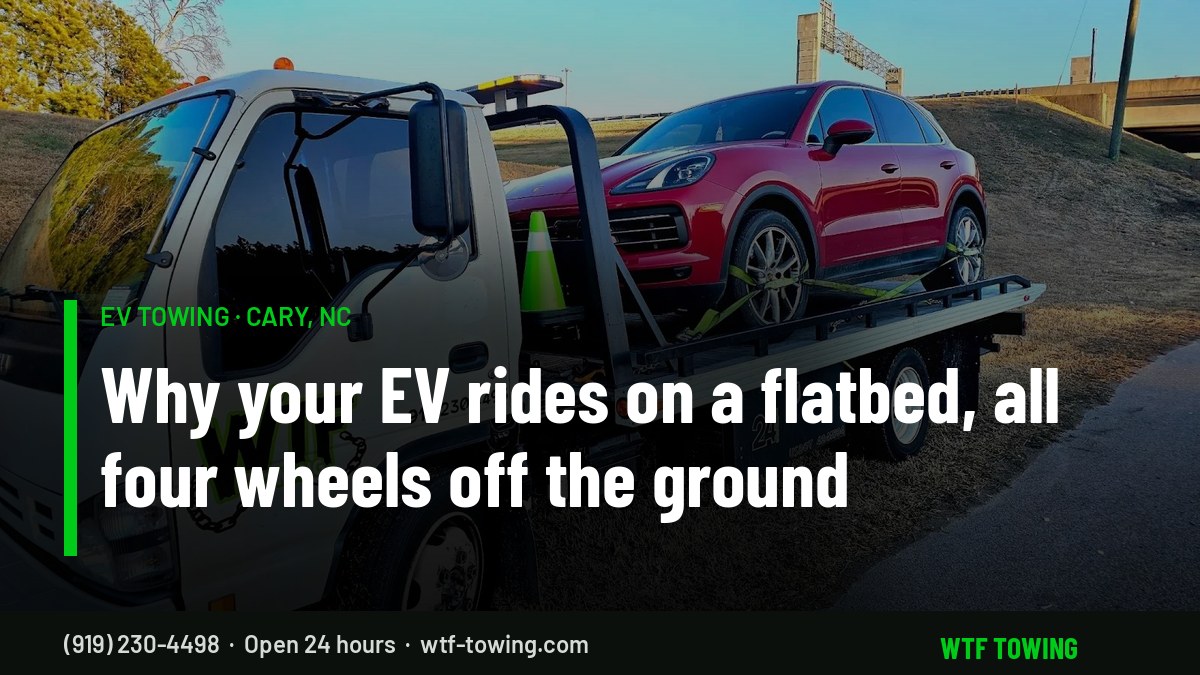
An electric vehicle should be towed on a flatbed with all four wheels off the ground, because its motors turn whenever its wheels do and can overheat when the car is dragged. For EV towing in Cary, NC, call WTF Towing at (919) 230-4498 and say “it’s electric”; one of our two rollback carriers comes the first time.
Here’s why that is, how our driver loads an EV that won’t even power on, and what to have ready when you call.
Why an EV can’t be towed like a gas car
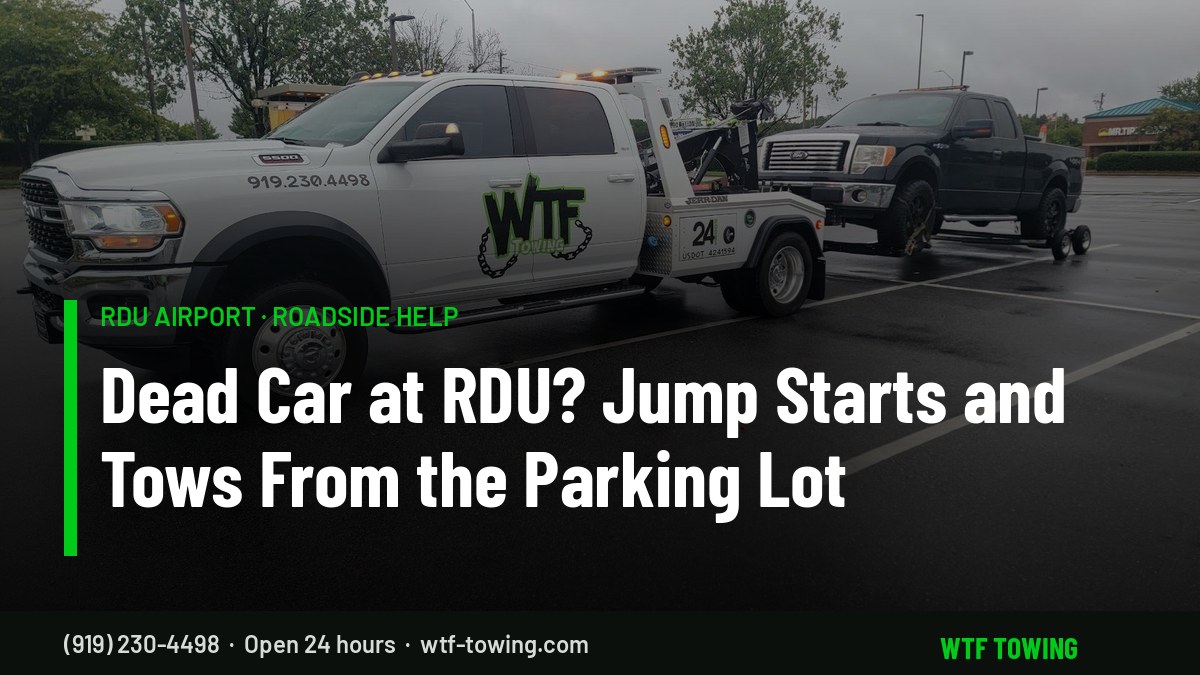
Put a gas car in neutral and the engine lets go of the wheels. Lift the drive wheels, let the other two roll, and nothing inside is harmed. That’s how our Ram 5500 wrecker and its wheel-lift move most front- and rear-wheel-drive cars.
Most EVs have no neutral like that. Each motor is geared straight to its wheels, so when the wheels turn, the motor turns and makes electricity. Tesla’s Model Y manual puts it in one line: “The motors in Model Y generate power when the wheels spin.” Tesla warns of significant damage and overheating. Rivian’s tow operator guide says flatbed only and adds that extreme overheating can cause a fire.
On a dual-motor EV there’s no safe end to lift, because both axles are driven. A flatbed is the one method every maker approves, and it’s the only way we tow them. Our guide to tow truck types and which truck your car needs covers every other kind of vehicle.
Why EVs end up on a tow truck in Cary
It’s usually not the big battery failing. The common reasons are ordinary:
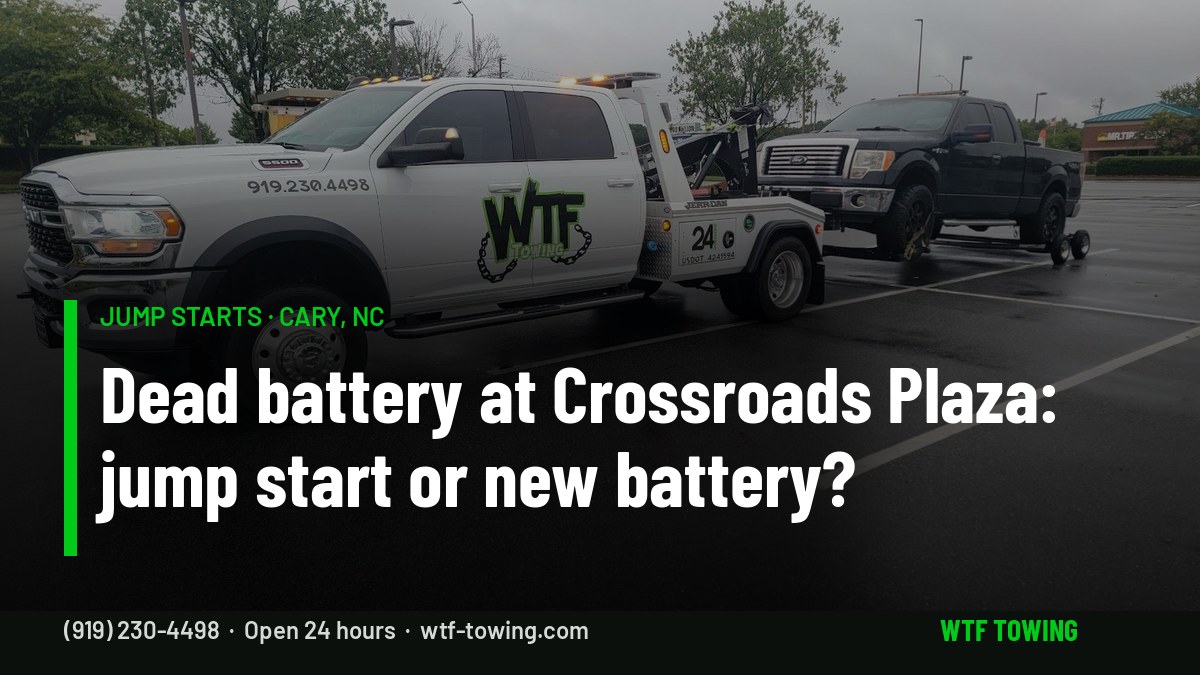
- A dead low-voltage battery. Every EV also has a small battery, 12 volts in most cars, that runs the computers and the switches that connect the main pack. When it dies, the car is a brick even at full charge. A week parked in a deck at RDU can do it. A jump start on the low-voltage side often wakes it up; our post on dead batteries at Crossroads Plaza covers what our driver checks.
- Out of charge. A cold morning, a detour around a wreck on I-40, a charger that’s out of order. The car warns you, cuts power, then stops. The main battery can’t be jump-started; the fix is a flatbed ride to a charger.
- A flat and no spare. Many EVs ship without a spare. If the tire can’t be sealed or a pothole bent the wheel, it’s a tow to a tire shop. With a spare, it’s a tire change, not a tow.
- A drive-system warning. “Pull over safely,” reduced power, or a car that won’t shift into Drive.
- A crash, or a hard hit underneath. The battery pack is the floor of the car. After either one, it gets towed and inspected, not driven.
Where it happens matters too. On US-1, reaching Exit 101 at Walnut Street, Exit 99 at Cary Parkway or Exit 98A at Tryon Road beats stopping on the shoulder. On NC-540 and I-40 through RTP, the shoulder is no place to troubleshoot; our I-40 and I-440 breakdown checklist covers what to do.
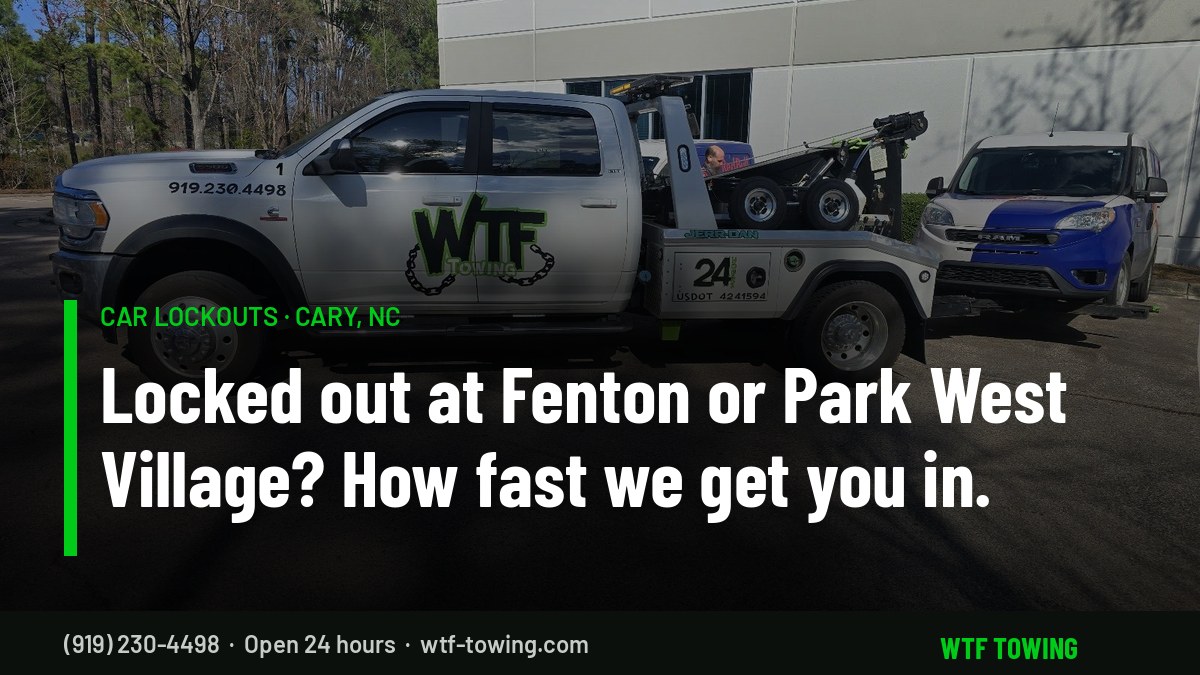
Plenty of EVs also go quiet right where they’re parked: the decks at Fenton and in downtown Cary, an office deck in RTP, a driveway off Green Level Church Road.
What our driver does to load an EV
The rollback lines up with the car and its 21-foot Jerr-Dan bed tilts down to the pavement. What happens next depends on whether the car will wake up.
If it powers on, the driver puts it in the maker’s towing setting so the wheels roll free and the parking brake stays off. On a Tesla that’s Tow Mode, which older manuals call Transport Mode. On a Rivian it’s a park-brake release in the service menu that shuts itself off after 15 minutes, so it gets switched on right before the pull.
The winch line goes to the screw-in tow eye that came with the car, never to a suspension arm or anything under the floor. The car comes up the bed at a crawl, the only time its wheels turn. Tesla’s manual allows that at under 5 mph for less than 30 feet, which is all a 21-foot bed needs.
If it’s dead, the driver boosts the low-voltage battery first, which is often enough to wake the screen and release the brake. If not, skates go under the locked wheels and the car slides up the bed. That’s the method Tesla’s own instructions give.
On the bed, the car goes into Park and the tires are strapped down at all four corners. Nothing goes through the wheels, around the suspension or over the body; you can see those straps in our photo tour of the trucks. Send the key card or fob with the car, because it has to wake up again to roll off.
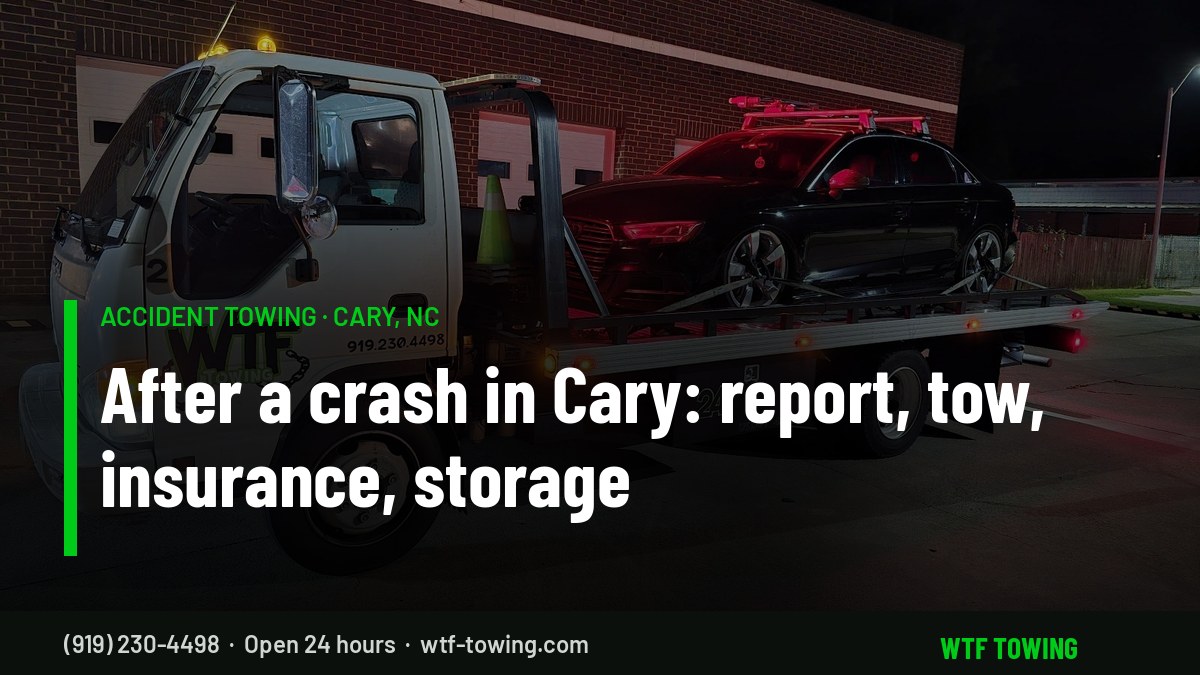
Decks and garages change the job. A rollback is long and tall, and many parking decks won’t take it. There our Ram 5500 wrecker goes in first: one end of the car on the wheel-lift, dollies under the other, all four wheels still off the ground, out to where the rollback can load. In a home garage with the wheels locked, it’s skates and patience.
What to do when your EV quits
- Use the last of the power to get out of traffic. An EV that’s running low slows down before it stops. Take the next exit or parking lot; don’t stretch for a charger.
- Turn the hazards on. On a highway, if the whole car is past the white line and nothing is smoking, stay in it, belted. If it’s partly in a lane, get everyone out and behind the guardrail.
- Smoke, a sharp chemical smell, or popping or hissing under the car? Get everyone well back and call 911 before you call us.
- Don’t let anyone pull it. No tow strap behind a friend’s truck, and no wheels-down tow “just to the charger.”
- Call (919) 230-4498 and say “electric.” That one word decides which truck leaves.
- Have the details ready: year, make and model; single or dual motor; whether the screen comes on and what it says; state of charge; any crash damage; and exactly where the car is, down to the deck level or nearest exit.
- Find the tow eye and the key card. The tow eye is usually in the front trunk or under the cargo floor.
- Pick the destination: your home charger, a public fast charger, or the service center or shop of your choice. Confirm the shop works on EVs before we load.
Mistakes that cost EV owners money
- Not saying it’s electric. The wrong truck shows up and you wait for a second one.
- Agreeing to a wheels-down tow because it’s “only two miles.” The makers’ warnings don’t come with a safe distance.
- Restarting the car over and over after a drive-system warning. Write down what the screen says and leave it alone.
- Putting a crash-damaged EV in the garage. Federal guidance for tow operators says a severely damaged EV shouldn’t be stored inside a structure or within 50 feet of a structure or another vehicle. At home, that means outside, away from the house, until it’s inspected. Don’t charge it, either.
What EV towing costs: the factors
No two EV tows are the same job. What moves the number:
- Distance. Usually the biggest factor, and an EV may have to go farther because not every shop works on them. A run to the shop or service center of your choice in Raleigh or Durham is a normal job; a long-distance tow is quoted on its own.
- Whether it rolls. An EV that wakes up and rolls loads like any other car. Locked wheels mean skates and more time.
- Where it’s sitting. A deck or tight garage can put both trucks on the job. A car that’s off the pavement needs a winch-out first.
The truck isn’t a choice: an EV rides the flatbed either way, so there’s no cheaper wheel-lift option to weigh. Tell us the details and we’ll quote it on the phone; our post on what drives the price of a tow in Cary walks through each factor. If your insurance roadside plan reimburses tows, ask us for an itemized receipt.
EV towing questions
Can an EV be towed a short distance with two wheels on the ground?
Not by us. Tesla requires all four wheels off the ground and Rivian’s guide says flatbed only. The one exception is the slow, short roll onto the bed.
My EV is completely dead and stuck in Park. Can you still move it?
Yes. The driver boosts the low-voltage battery first. If the brake still won’t release, the car slides onto the bed on skates.
Do hybrids and plug-in hybrids need a flatbed too?
We send the rollback for them. Many are all-wheel drive, and a flatbed is safe for every drivetrain.
WTF Towing handles towing in Cary, NC, plus Morrisville, Apex, Holly Springs, New Hill, RTP and RDU Airport, with runs into Raleigh and Durham. If you’re searching for a tow truck near you in Cary that knows what an EV needs, we answer 24 hours a day.
When your car makes you say WTF, you call WTF Towing. We’re licensed and insured (USDOT 4241594, MC 1642674, $1,000,000 liability): (919) 230-4498.