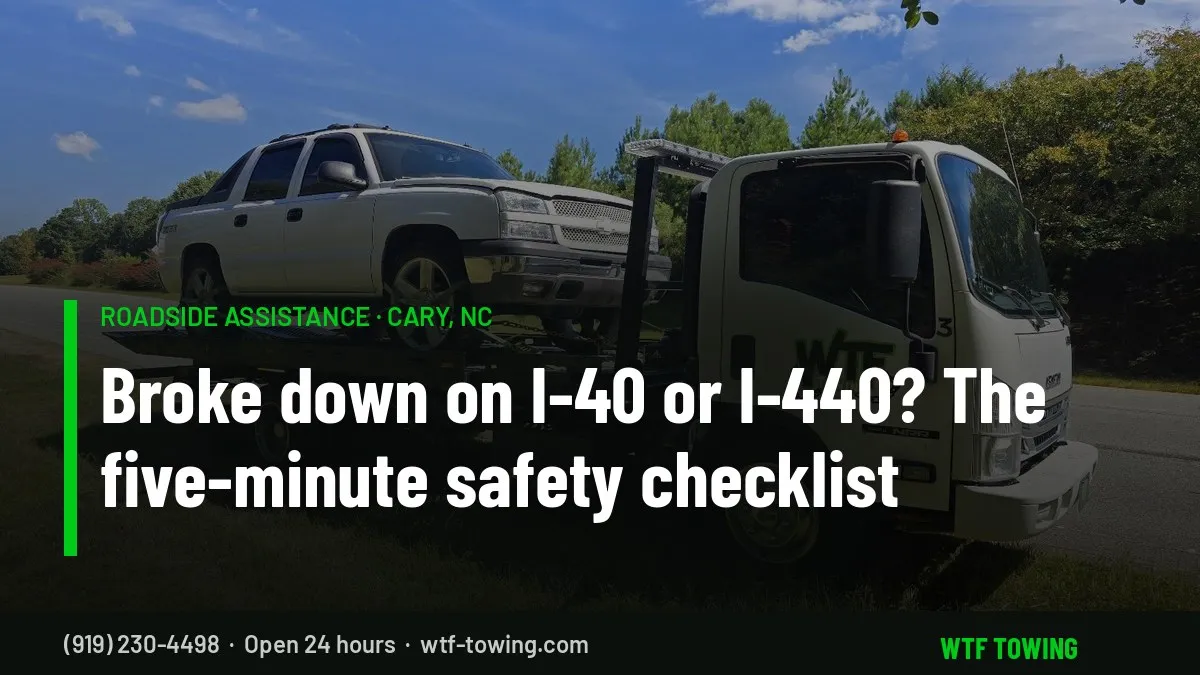
If your car quits on I-40 or I-440 near Cary, the first five minutes matter most. Get as far right as the car will roll, hazards on, stay belted inside if you’re fully off the travel lanes, pin down exactly where you are, and call a truck that is already close: WTF Towing runs I-40 and the Beltline around the clock from the Cary–Morrisville area at (919) 230-4498.
We wrote a similar guide for breaking down on US-1 in Cary; this one is for the interstates, which are faster, wider and less forgiving. It’s most of what roadside assistance in Cary, NC comes down to on a highway shoulder.
Why I-40 and I-440 are different from a Cary street
I-40 through Cary and Morrisville carries the RTP commute, the airport traffic off Airport Boulevard (Exit 284), and everything moving between Raleigh and Durham. From Aviation Parkway (Exit 285) to the US-1/US-64 and I-440 split at Exit 293, the road runs against a concrete barrier or guardrail on the left for long stretches, leaving a narrow left shoulder.
I-440 starts at that interchange and loops around Raleigh. Its western end, past Jones Franklin Road (Exit 1C), Melbourne Road (1D), Western Boulevard (2) and Wade Avenue (3), was rebuilt a few years ago and moves fast. We’ve covered wrecker service on the I-440 Beltline before; one detail worth repeating: the Beltline is signed east and west, not “inner” and “outer,” and a dispatcher can’t find you with the old names. Add overnight work zones with barrels where the shoulder used to be, and a dead car in a live lane is the most dangerous thing on the road.
The five-minute checklist
- Signal right and keep rolling. Use your momentum to reach the right shoulder, a ramp or the next exit. Right over left every time; the left is narrow, against the barrier, and no tow truck can work there safely.
- Hazards on, wheels right, brake set. Turn the front wheels away from traffic so a bump from behind pushes the car onto the grass, not into the lane. At night, turn on the interior light too, so the car reads as occupied.
- Decide: stay in or get out. Fully on the shoulder with no smoke or fuel smell? Stay belted in the car. Partly in a lane, pinned against a wall, or smelling fuel? Get out on the side away from traffic and behind the guardrail.
- Pin your location. Direction first (I-40 east toward Raleigh or west toward RTP and Durham; I-440 east or west), then the last exit, the next exit, and the mile marker if you can see one. “I-40 west, just past Harrison Avenue, Exit 287, right shoulder” gets a truck to you. “On 40 near Cary” does not.
- Make the right call. If any part of the car is in a lane, anyone is hurt, or you feel unsafe, call 911 first so a patrol car with lights can get behind you (*HP, or *47, also reaches the Highway Patrol). Then call us at (919) 230-4498.
- Be visible, not a target. Don’t stand behind the car, between the car and traffic, or lean into the engine bay on the traffic side. Set out triangles only from the shoulder side.
- Wait smart. Keep the phone charged and the ringer on. If a tow truck you didn’t request pulls up, ask who dispatched it before anyone hooks anything. When ours arrives, stay put and let the driver come to your window.
Stay in the car or get out? The one decision that matters most
People get hurt on interstate shoulders when they are outside the car, where a drifting driver ends up. So the default is simple: if the whole car is beyond the white line, on a full-width shoulder or the grass, and nothing is smoking or leaking, stay in it, belted, hazards on, and wait.
Get out when staying in is the bigger risk: any part of the car still in a lane; a shoulder so narrow a passing mirror could clip your door; smoke, fire or the smell of gasoline. Exit through the door away from traffic, take everyone with you, and go where a car cannot follow: behind the guardrail or up the embankment, never directly in front of or behind your car, because a struck car moves toward those spots. Don’t cross the interstate on foot or walk the shoulder to an exit. After dark, our night-driving safety guide adds a few more habits.
Tell us exactly where you are, and what to have ready
A vague location slows the truck down. On I-40 the exit numbers run west to east through our area: I-540 (283), Airport Boulevard (284), Aviation Parkway in Morrisville (285), Harrison Avenue in Cary (287), Wade Avenue (289), NC-54 (290), Cary Towne Boulevard (291), and the split at 293, where US-1 south and US-64 west peel off toward Apex and I-440 begins.
Then have these ready: direction and which shoulder; make, model and color; whether the car is all-wheel drive, four-wheel drive, electric or a hybrid, which decides the truck we send; what happened; how many people are with you, including kids in car seats and pets; and where the car should go. If your insurance roadside plan reimburses tows, ask us for an itemized receipt.
A shoulder call doesn’t always end in a tow. For a dead battery, a shredded tire or an empty tank we’ll often do the jump start, tire change or fuel delivery on the spot if the shoulder is wide enough to work safely; if it isn’t, we hook the car and move it to the next exit first.
What the WTF Towing driver does when the truck pulls up
You’ll see the amber lights first. The driver parks the truck angled behind your car, a little wider and a length or so back. That position is deliberate: the truck is a shield between the work and the travel lane. North Carolina’s Move Over law requires drivers to change lanes or slow down for a stopped tow truck with its lights on, but plenty don’t, so the driver sets up as if nobody will.
Next, the driver walks up on the shoulder side, checks on everyone, confirms the destination, and gets you into the cab. Then the hookup. For a front- or rear-wheel-drive car with nothing bent underneath, that’s our Ram 5500 wrecker with the Jerr-Dan wheel-lift: the yoke slides under the front tires, the car comes up, and you’re moving in minutes. AWD and 4WD vehicles, EVs and hybrids, lowered cars, and anything with crash damage go on one of our two Isuzu NRR rollbacks with 21-foot Jerr-Dan beds, all four wheels off the road; our guide to tow truck types explains why.
On a narrow shoulder, the driver may hook quickly, pull to the next exit or a wide spot, and finish securing the car there; that’s getting everyone away from the lanes first, not corner-cutting. Where the car goes is your call: a shop in Cary, home to Morrisville or Holly Springs, a body shop in Raleigh, a service department in Durham, or, for Greensboro, Charlotte or the coast, long-distance towing on a rollback.
Common mistakes we see on I-40 and I-440
- Stopping on the left shoulder when the right was reachable. Nobody can work safely against the median wall. If you’re already there, stay belted inside and tell us on the phone.
- Getting out to look at the damage. Behind the car or at the traffic-side tire is exactly where a distracted driver ends up. Look later, in a parking lot.
- Changing a tire on the traffic side. Your back is to the lane while you crouch. Let a truck pull you to the exit, or let us do it with the truck as a shield.
- Creeping along in the lane on a shredded tire. A car crawling in interstate traffic is a target. Get onto the shoulder and stop.
Common questions
Should I call 911 or the tow company first?
Car in a lane, anyone hurt, or you feel unsafe: 911 first, then us. Fully on the shoulder with a mechanical problem: call us directly at (919) 230-4498.
My car is an EV or all-wheel drive. Does that change anything?
It changes the truck, not the plan. Say “electric” or “all-wheel drive” when you call and a rollback comes instead of the wheel-lift. If the car has a tow or transport mode, switch it on; the driver handles the rest.
What decides what an interstate tow costs?
Distance to reach you and then to your destination; which truck the car needs; nights, weekends and holidays; how complicated the scene is, from a lane that must be cleared fast to a car down an embankment that needs winching first; and whether the car goes to a shop or into storage. You get a straight quote before the truck rolls; our post on what drives tow prices in Cary goes deeper.
Can you take me to Raleigh, Durham or my shop in Apex?
Yes. Cary, Morrisville, Apex, Holly Springs, New Hill, RTP and RDU are home turf, and we run jobs into Raleigh and Durham. You ride in the cab.
If the car can be fixed where it sits, our 24/7 roadside assistance in Cary covers jump starts, flat tires, fuel and lockouts.
The plan is simple: right shoulder, hazards, stay belted, know your exit, make the call. When your car makes you say WTF, you call WTF Towing: 24 hours a day, licensed and insured, from the Cary–Morrisville area, at (919) 230-4498.
