If you hit a deer on NC-55 or Green Level Church Rd, pull off somewhere safe, turn on your hazards, check everyone for injuries, and stay away from the animal. Then look over the car before you drive another mile, because a deer strike often does its worst damage behind the bumper, where you can’t see it.
If the car isn’t safe to drive, WTF Towing runs 24/7 across the Cary area. Call (919) 230-4498 and we’ll get it to your home or the shop of your choice. The rest of this page covers what to do at the scene, how to judge the damage, which truck comes, and how to handle the police report and the insurance claim.
Why deer strikes pick up in Cary this time of year
Deer move most around dusk and dawn, and they move more in fall during breeding season. When the clocks go back in November, the evening drive home lands right in that window. NCDOT warns drivers about it every fall, and our fall road safety guide puts deer on the list of things that fill the tow calendar.
Western Wake County gives them plenty of cover. Subdivisions keep going up beside woods and creek corridors, so deer live right alongside fast roads. These are the places to slow down and watch the edges:
- NC-55 through Apex, west Cary and Morrisville, where traffic moves quickly past wooded stretches and new development.
- Green Level Church Rd and the roads around it in western Cary, where farmland and tree lines still meet new neighborhoods.
- O’Kelly Chapel Rd and Carpenter Fire Station Rd, darker two-lane roads heading toward the Jordan Lake side of the county.
- Kildaire Farm Rd near Hemlock Bluffs Nature Preserve.
- NC-540 and I-40 near the big green spaces, including Umstead State Park. Higher speed means a harder hit.
Deer often travel in groups, so if one crosses in front of you, expect another behind it. If one steps out too close to avoid, brake hard and stay in your lane if you can. Swerving is how a damaged bumper becomes a tree, a ditch or oncoming traffic.
What to do after you hit a deer
- Get out of the lane. If the car moves and steers normally, pull onto the shoulder or into the nearest parking lot or side street. If it won’t move, leave it where it is.
- Turn on your hazards. At night, leave the headlights on too if they still work.
- Check everyone in the car. If anyone is hurt or you aren’t sure, call 911 and say so.
- Stay away from the deer. An injured deer can kick hard and may get back up without warning. Don’t try to move it or check on it.
- Call it in. Call 911 if the car or the deer is blocking traffic. Tell the dispatcher the road, your direction and the nearest cross street.
- Take photos. Get all four sides of the car, close-ups of the damage, any hair or blood on the bumper, the road and the deer from a safe distance. These help with the claim later.
- Check the car using the list below before deciding whether to drive it.
- Call your insurance company and open the claim, then call for a tow if you need one.
On a fast road with no shoulder to speak of, don’t stand beside the car while you make these calls. Stand well away from traffic, behind a guardrail if there is one. Our guide to what to do after a crash in Cary goes deeper on the report and storage.
Drive it or tow it? What to check first
Deer usually hit low and in front, which is where your radiator, air-conditioning condenser, cooling fan and headlights sit. A plastic bumper can look almost fine with a cracked radiator behind it. Walk around the car with your phone light and look for these:
- Fluid on the ground or steam from the hood. Green, orange or pink liquid usually means coolant. Without coolant, an engine can overheat quickly and turn a body repair into an engine repair.
- A bumper or fender touching the tire. Bent sheet metal can cut a tire within a short distance.
- A hood that won’t latch. If it could fly up at speed, the car stays put.
- Broken headlights after dark. One working headlight on an unlit road is how you end up in a second crash.
- Airbags that went off. Have the car towed.
- Dash warnings. A temperature warning, oil light or flashing red warning means don’t drive. A driver-assist warning may just mean a grille sensor got hit, but have it checked before you trust those systems.
- Odd steering or noise. Pulling to one side, vibration, or scraping up front.
If all of that checks out, start it and watch the temperature gauge for a few minutes before moving. Then drive straight to your destination by the slowest, simplest route. If you’re on the fence, especially with a hybrid or EV with front-end damage, get it towed. You can’t see a coolant or battery-cooling leak from the driver’s seat. If you’re looking for a tow truck near you in Cary, we can talk it through on the phone before you decide.
What the driver does, and which truck comes
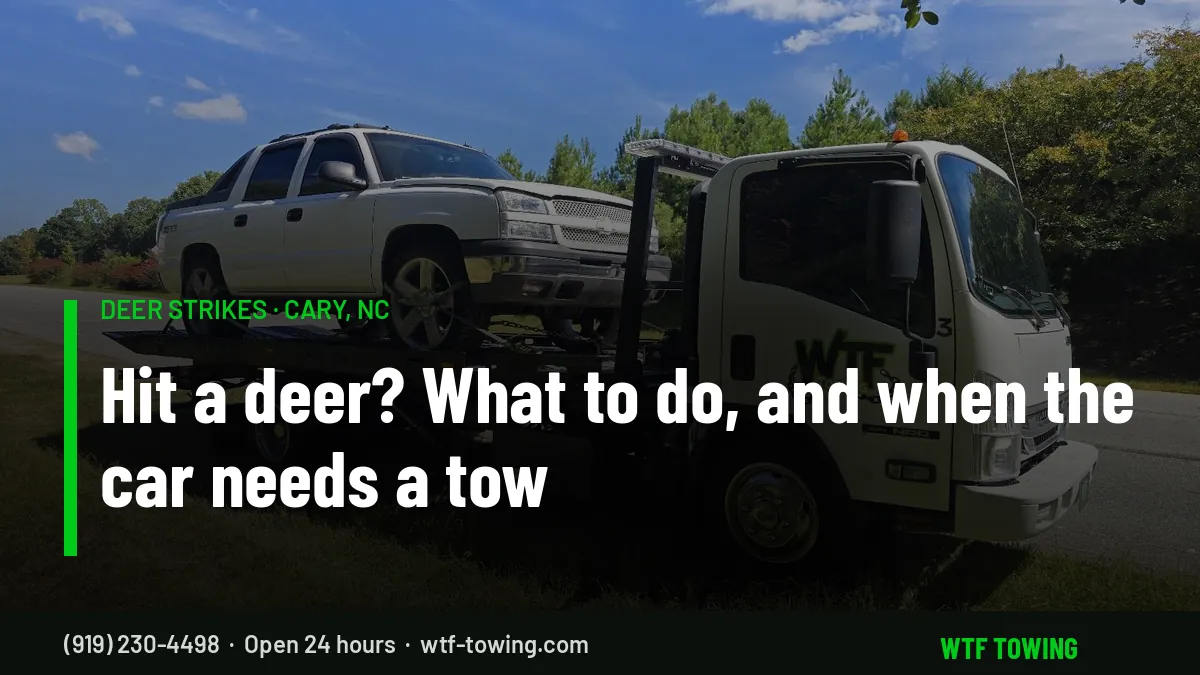
Most deer-strike cars ride best on one of our two Isuzu NRR rollbacks. The whole car sits on a 21-foot Jerr-Dan bed, so nothing damaged is left rolling or dragging. That matters for all-wheel-drive vehicles, for EVs, and for any car with a damaged wheel or suspension up front.
When the driver arrives, here’s the order:
- Looks over the front end, checks ground clearance and finds a solid point to attach to.
- Secures anything loose, such as a hanging bumper or splash shield, so it can’t catch on the ramp or fall off on the highway.
- Winches the car up slowly, then straps it down at the wheels.
Our Ram 5500 wrecker with its Jerr-Dan wheel-lift is the better fit in tight spots or when the damage leaves one end of the car sound and the car can safely ride with that end lifted. If you swerved and the car left the pavement, a winch-out comes first. Our winching service gets the car out of the ditch or soft grass and back on solid ground before it’s loaded.
Police report and insurance: what to have ready
Ask for a police report even if it feels like a formality. In North Carolina, a crash is reportable if someone is injured or killed, or if the property damage reaches $1,000. Bumper, grille and headlight damage on a late-model car can get there fast. If in doubt, call and let the officer decide. Get the report number and the officer’s name before you leave.
When you call for the tow, have this ready:
- Your location: road, direction, and nearest cross street or landmark.
- Year, make and model, and whether it’s front-wheel, all-wheel or electric.
- Whether it rolls, steers and shifts into neutral, and whether a wheel is damaged.
- Whether it’s in a lane, on the shoulder or off the road.
- Where it’s going: home or the shop of your choice.
If your insurance roadside plan covers towing, call them first and ask how it works. Otherwise, call us directly. Keep the receipt either way, since your policy may reimburse the tow. Before the car leaves, take out your wallet, keys, child seats and anything else you’ll need.
What a tow after a deer strike costs, in terms of factors
These details set the price of your tow:
- Distance to your drop-off point.
- Recovery work. A car off the road and in the ditch needs winching before the tow starts.
- Condition of the car. Locked wheels or heavy front damage take more time and equipment.
- Vehicle size and drivetrain. These affect which truck and which setup we use.
- Time and place. Late nights and busy highways make a job harder to work safely.
Give accurate details on the call and ask for the price before we roll. Going straight to the final stop also saves you a second tow later.
When your car makes you say WTF, you call WTF Towing. We cover towing in Cary, NC day and night, along with Apex, Morrisville, Holly Springs, RTP and the rest of the NC-55 corridor.
Deer collision FAQ
Is hitting a deer covered by insurance?
Usually, a deer strike falls under comprehensive coverage rather than collision. If you swerved and hit something else, it may be treated as a collision claim instead. Policies vary, so check yours. This is general information, not insurance or legal advice.
Do I have to call the police if I hit a deer?
North Carolina requires drivers to notify law enforcement after a reportable crash, which includes injuries or $1,000 or more in property damage. Damage is hard to estimate at the roadside, so calling is the safer choice.
The car still runs. Can I just drive it home?
Only if there are no leaks, the hood latches, nothing touches a tire, the lights work, there are no warning lights, and the temperature stays steady. If any of those fail, have it towed.
Can you tow my car to a body shop at night?
We run 24/7, but drop-off depends on the shop. If it has no after-hours drop, we can take the car home and you can arrange the rest in the morning.
Hit a deer somewhere around Cary? Call (919) 230-4498, any hour.
