After a crash in Cary, the order is simple: get safe, call 911, trade information, take photos, then decide where the car goes before the tow truck leaves with it. For accident towing in Cary, NC, call WTF Towing at (919) 230-4498, any hour; the rest of this page walks through the police report, the tow, the insurance claim and storage, in the order they actually happen.
One note up front: this is general information from a towing company, not legal advice.
The first ten minutes: safety, then 911
Check yourself and your passengers first. If anyone is hurt, or you aren’t sure, call 911 and say so.
If nobody is hurt and the cars still drive, North Carolina law expects you to get them out of the travel lane and onto the shoulder or a nearby lot as soon as you safely can. That matters most on US-1 and US-64 through the Crossroads area and on I-40, where a stopped car in a live lane is how one crash becomes two. On Cary Parkway, Kildaire Farm Rd or Tryon Rd, the nearest shopping-center entrance beats the middle of the road.
If the car won’t move, turn on the hazards, and get everyone out and well away from traffic if you can do it safely: behind the guardrail on a highway, up on the sidewalk or grass in town. Our I-40 and I-440 breakdown checklist covers when to stay buckled in the car and when to get out; the same rules apply after a wreck.
The police report: when you need one and how to get a copy
In North Carolina, a driver in a “reportable” crash has to notify law enforcement right away. Reportable means someone was injured or killed, or the property damage adds up to $1,000 or more. When in doubt, call.
Inside town limits, Cary Police respond; on the interstates it is often the State Highway Patrol. Whoever shows up, do two things:
- Get the report number and the officer’s name before you leave the scene.
- Ask how to get the report. Officers write the report after the crash and it usually takes a day or two to reach the records office. For reportable crashes, copies come through the NC Division of Motor Vehicles, which charges a fee; the Cary Police Records Unit can point you the right way for a Cary crash.
What to do at the scene, in order
- Get safe. Hazards on, people out of traffic, cars out of the lane if they’ll drive.
- Call 911. Give the road, the direction you were heading and the nearest cross street or exit. On US-1 in Cary, that might be “southbound near Exit 101, Walnut Street.”
- Exchange information. Name, phone, driver’s license, plate number, and insurance company and policy number for every driver involved.
- Take photos. All four sides of every vehicle, the plates, the position of the cars before they’re moved if it’s safe to shoot, skid marks, debris, and the intersection or mile marker.
- Decide where the car is going. Home, a body shop you trust, or a storage yard. Have an answer before the tow truck is hooked up.
- Call for the tow. Tell the officer you have a truck on the way.
- Empty the car. Wallet, phone, house keys, garage-door opener, medication, child seats.
- Call your insurance company and open the claim, from the scene if you can.
The tow: who calls it, which truck comes, what the driver does
If your car can’t be driven, somebody has to move it, and you generally have a say in who. Tell the officer you’d like to call your own tow company. If you don’t have a preference, can’t make the call, or the car is blocking a lane and has to go immediately, the officer will call the next company on the agency’s rotation list. Either way, ask where the car is being taken and get the tow company’s name and phone number before it leaves. Our guide to North Carolina towing laws and your rights on the shoulder goes deeper on that.
When you call us, have four answers ready: exactly where the car is (in the road, on the shoulder, or off in a ditch), whether all four wheels roll and steer, whether it’s all-wheel drive, an EV or a hybrid, and where it’s going. That’s how the right truck leaves the yard.
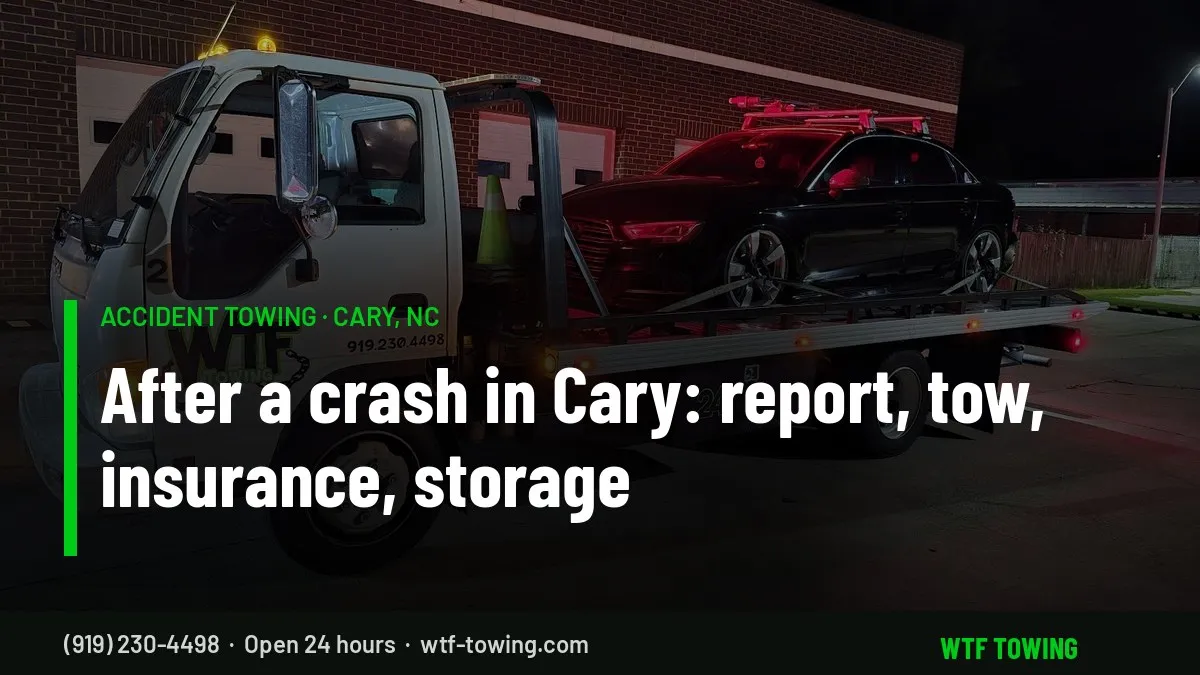
Most wrecked vehicles ride on a flatbed. A car with a broken suspension, a locked wheel or drivetrain damage shouldn’t be dragged down the road on its own tires, so one of our Isuzu rollback carriers tilts its 21-foot Jerr-Dan bed to the ground and winches the car up. If a wheel won’t turn, the driver uses skates or blocks under it so the car slides onto the bed instead of grinding. Then it’s strapped at four points and the bed levels out.
When the car is somewhere a rollback can’t line up on, like a tight corner of a parking deck or wedged against a curb, our Ram 5500 wrecker with the Jerr-Dan wheel-lift can pull it into the open first. If it left the pavement, that’s a winch-out before it’s a tow.
The driver also picks up the bumper covers and big debris, and you get a receipt showing where the car went. Keep it; your adjuster will ask for it.
Insurance and storage: the calls to make, and why days matter
Call your own insurance company the same day, even if the other driver was clearly at fault. You’ll get a claim number, and every shop, yard and adjuster will ask for it from here on. On that first call, ask:
- Is the tow from the scene covered, and do I pay and submit the receipt or do you handle it?
- Where do you want the car inspected: at the shop I choose, or somewhere else?
- Is storage covered, and for how many days?
If you have an insurance roadside plan, it may send a truck for you. If the wait is long and you’re on the shoulder of US-1 at rush hour, you can call a local company directly and ask your insurer how reimbursement works.
If you don’t know where the car should go, or the shop is closed for the night, it goes to a storage yard. Nearly every yard bills storage by the day, and the bill grows until someone moves the car. To keep it short:
- Tell your adjuster where the car is right away, with the yard’s name, address and phone number.
- Ask the yard what it needs to release the car: usually a photo ID, proof you own it, and payment of the tow and storage charges.
- If it’s likely a total loss, ask your insurer to move it to their own facility quickly.
- If it’s repairable, a second, shorter tow from the yard to the body shop starts the repair and stops the storage clock.
The cheapest storage is none. If the car can go straight to your driveway or a body shop, say so when you call.
What accident towing costs, and the mistakes that cost more
We don’t post one flat price for accident tows, because no two are the same job. What moves the number:
- Distance from the scene to the drop-off. A tow across Cary is not the same as a run to a shop in Raleigh or a long-distance tow to your hometown mechanic.
- Recovery work before the tow: winching out of a ditch, off a median or out of the trees.
- Storage days, if it goes to a yard, and a second tow later.
Tell us what happened and where it’s going and we’ll quote it on the phone. Our post on what drives the price of a tow in Cary breaks the factors down further.
The mistakes we see most often:
- Standing between the cars or in the lane to look at damage. Get off the road first.
- Skipping the police report because the other driver seems nice. Stories change by Monday.
- Driving a damaged car “just to get home.” A leaking radiator, a bent wheel or a rubbing tire can turn a repairable car into a second wreck.
Accident towing FAQ
Can I choose my own tow company after a crash in Cary?
Generally, yes. Tell the officer you’re calling your own truck. If the car is blocking traffic and has to move right now, or you aren’t able to call, the officer will use the rotation list. Ask where the car is going either way.
Do I have to call the police for a minor fender bender?
North Carolina requires you to notify law enforcement when there’s an injury or at least $1,000 in property damage. A report also protects you if the other driver’s story changes. We’d call.
My car is an EV or all-wheel drive. Does that change the tow?
Yes. It goes on a flatbed with all four wheels off the ground. Tell us when you call, and tell us if the battery area took the hit or you see smoke or smell something sharp; stay well back from the car if you do.
We run accident tows across Cary, Morrisville, Apex, Holly Springs, New Hill, RTP and RDU, and into Raleigh and Durham; the full list is on our towing service page.
When you are ready for the tow itself, here is how our accident towing in Cary works, start to finish.
When your car makes you say WTF, you call WTF Towing. We’re licensed and insured (USDOT 4241594, MC 1642674, $1,000,000 liability) and we answer 24 hours a day: (919) 230-4498.
