If you just put diesel in a gas car, or gas in a diesel, the most important thing is simple: don’t start it. Leave the key off, put the car in neutral, push it clear of the pump, and call a tow truck so the tank can be drained at a shop before any of that fuel reaches the engine.
It happens: a rental, a borrowed work truck, a phone call at the pump on Kildaire Farm Rd at 6 a.m. What you do in the next two minutes decides whether it’s an inconvenience or a big repair bill.
Why you don’t start it, and why you don’t even turn the key
As long as the wrong fuel is sitting in the tank, it’s mostly harmless. The damage starts when the fuel pump pushes it through the lines, filter, pump and injectors and into the engine.
Here’s the part most people miss: on many cars, turning the key to “on” or pressing the start button without your foot on the brake wakes up the fuel pump and primes the system for a few seconds. So don’t turn the key to check the dash, and don’t “just see if it starts.”
Gas in a diesel is the more expensive mistake. Diesel fuel lubricates the high-pressure fuel pump in a modern diesel truck or SUV. Gasoline acts like a solvent and strips that lubrication away. Run it, and the pump can wear itself out and send metal through the injectors. This one is also the easier mistake to make, because a standard gas nozzle often fits right into a diesel filler neck.
Diesel in a gas car is less common, since diesel nozzles are often larger and don’t fit a gas filler. When it does happen, the gas engine can’t burn diesel properly. You get rough running, smoke, misfires, a stall and fouled spark plugs.
Either way, the fix is the same: get the car to a shop without running it, and have the tank drained and the system flushed. That’s a job for the shop, not a roadside job. Draining a fuel tank in a gas station lot or on the shoulder of NC-55 is a fire and spill hazard.
What to do at the pump: a step-by-step list
- Stop pumping the second you notice. Less wrong fuel is always better.
- Leave the key off. Don’t turn it to “on,” don’t press the start button, don’t open a push-start car’s dash to check the gauge.
- Tell the station attendant. They may help you push.
- Put it in neutral and push it clear. With a helper, roll it to a parking spot off the pump island. On most automatics you’ll need the key in the accessory position or the shift-lock release to get out of park, so check your owner’s manual. If you can’t move it safely, leave it and let the tow driver handle it.
- Note what happened. Which fuel, roughly how many gallons, and whether the engine ran. The shop will ask.
- Call for a tow. Tell the dispatcher it’s a misfuel, what kind of vehicle it is, whether it’s all-wheel drive, and where you want it to go.
If you already drove away
Plenty of people don’t realize until the car tells them. With gas in a diesel, you’ll usually hear knocking, feel power drop off, and see the check-engine light or smoke within a few miles. With diesel in a gas car, it’ll sputter, smoke and run rough, often before you’re out of the parking lot.
The moment you notice, get off the road at the first safe spot and shut it off. Don’t try to limp it home or to the shop. If you’re on a busy road like US-1, I-40 or NC-540, follow the same rules as any breakdown: get as far right as you can, hazards on, and stay buckled in the car if the shoulder is narrow. Then call.
How the tow works for a misfueled car
A misfueled car tows like any other car that won’t run. The driver won’t start it to load it.
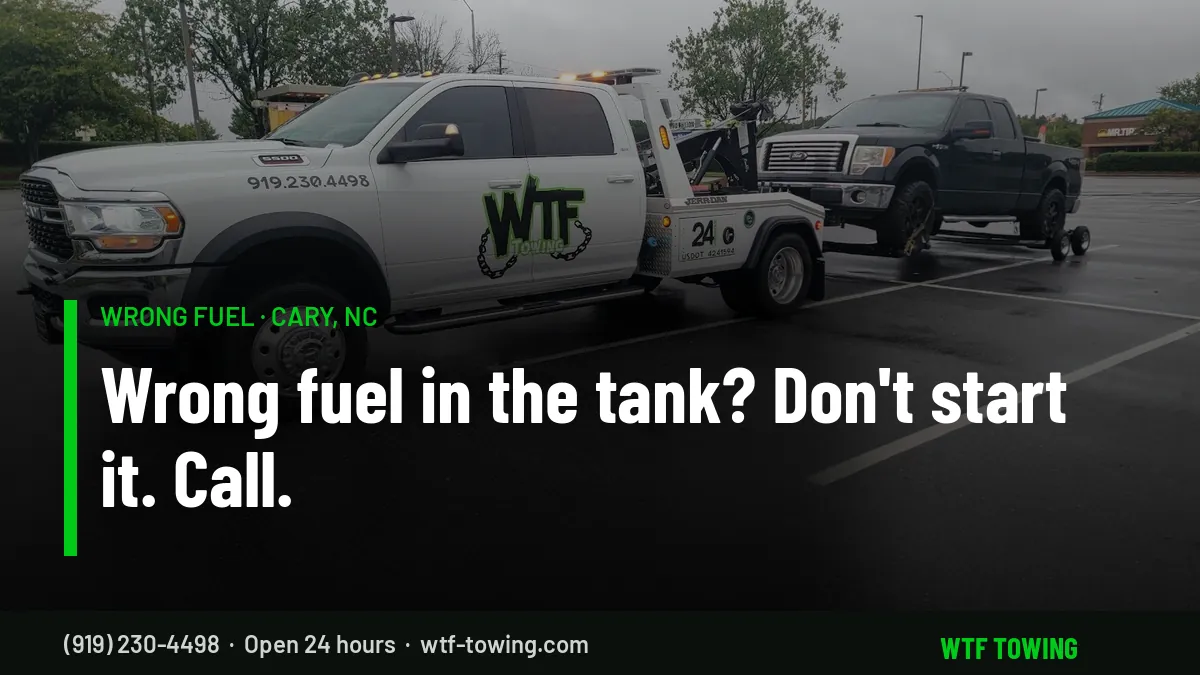
Rollback (flatbed): Our two Isuzu NRR rollbacks carry 21-foot Jerr-Dan beds. The driver tilts the bed, hooks the winch to a proper point on the frame and pulls the car up without it ever running. This is the right truck for all-wheel-drive cars, most EVs and hybrids, low or lowered cars, and anything with a long overhang. It’s also how heavy diesel pickups usually ride.
Wheel-lift: Our Ram 5500 wrecker with a Jerr-Dan wheel-lift picks up one end of the car by the tires. For a front-wheel-drive car going a short distance, lifting the front end is quick and works well in a tight gas station lot where a long rollback can’t line up.
Gas station lots around Cary can be tight, with pump islands, curbs and traffic cutting through from Tryon Rd or Davis Dr. If the car is still at the pump, the driver pulls it clear before loading. For more about how we choose hookup points and protect the car, see what our driver checks before hooking your car.
What to have ready when you call
- The exact location. The station’s street and nearest cross street, which side of the road, and which pump. “The station on NC-55 near the 540 interchange, pump 6” gets a truck to you faster than “a gas station in Cary.”
- Vehicle details. Year, make, model, gas or diesel, and whether it’s AWD or 4×4.
- What went in. Gas, diesel, or something else, and roughly how much.
- Whether it ran. Never started, turned the key only, or drove some distance.
- Where it’s going. The shop’s name and address, or ask us for a drop-off that works after hours.
- The key. The driver needs it to unlock steering and get the car in neutral.
Common mistakes that turn a cheap fix into a big one
- “Topping it off” with the right fuel to dilute it. It doesn’t make the wrong fuel safe. It just puts more fuel in the tank that now has to be drained.
- Starting it to move it off the pump. Push it, or let the tow driver move it.
- Driving it “just to the shop down the road.” A short drive is plenty of time to circulate the wrong fuel.
Diesel exhaust fluid poured into a diesel’s fuel tank gets the same rule: don’t start it, call.
What drives the cost
We don’t quote numbers online, because the honest answer depends on the job. What changes the price of the tow:
- Distance from the station to the shop.
- Vehicle type and weight. A compact car on the wheel-lift is a different job from a heavy diesel pickup on the rollback.
- Which truck it needs. AWD, EVs and lowered cars ride on the rollback.
- Time of day. We run 24 hours, and late-night calls can be priced differently.
- Access. A car stuck at a cramped pump takes more setup.
The repair side is set by the shop, and it mostly comes down to one thing: whether the engine ran. A car that never started usually just needs the tank drained and the fuel refilled. A diesel that ran on gasoline may need a fuel pump, injectors and lines. That’s why “don’t start it” is the whole point of this post. Check your auto policy and any roadside plan you have, too; some cover a misfuel tow, some don’t.
If you ran low and filled up in a hurry, next time our fuel delivery service can bring the right fuel to you, and our post on running out of gas in Cary covers what an empty tank does to your fuel pump. The same “don’t start it” rule also applies to water, which we cover in flooded road, flooded car.
Where we cover
We’re a locally owned, 24/7 company based in the Cary–Morrisville area, and we handle towing in Cary, NC along with Apex, Holly Springs, New Hill, RTP and RDU Airport. Misfuel calls come from stations at Crossroads, along Tryon Rd and Davis Dr, and off NC-540 and I-40. If you’re searching for a tow truck near you in Cary, that’s us. We also cover towing in Morrisville and handle towing in Raleigh and Durham.
We’re licensed and insured: USDOT 4241594, MC 1642674, with $1,000,000 in liability coverage. When your car makes you say WTF, you call WTF Towing.
FAQ
Can I drive a gas car with a little diesel in it?
Don’t. Even a small amount can cause rough running and fouled plugs. Leave it off and have the tank drained.
Is gas in a diesel really worse than diesel in a gas car?
Usually, yes. Gasoline strips the lubrication a diesel’s high-pressure fuel pump depends on, and if the engine runs, damage can spread to the injectors. A gas car with diesel in it is a mess to clean out, but it’s usually less costly if it wasn’t driven far.
Can you drain the tank at the gas station?
Draining fuel isn’t a roadside job. It needs a lift, proper containers and disposal, which a shop has and a parking lot doesn’t. We tow the car to the shop of your choice so it can be done safely.
Do you come out at night for a misfuel?
Yes. We’re open 24 hours, and early-morning and late-night fill-ups are exactly when this happens.
Put the wrong fuel in? Leave the key off and call WTF Towing: (919) 230-4498.
