Worried a tow truck will damage your car? A careful driver prevents almost all of it before the car ever leaves the ground, by picking the right truck, finding the right hookup points, checking clearance and strapping the car down properly. At WTF Towing we also photograph your car at pickup and again at drop-off, so there is never a question about what condition it was in.
Most towing damage comes from rushing: a chain around a suspension arm, a bumper dragged up a ramp, a strap across a brake line. Here is what our driver looks at on every call around Cary, Morrisville and Apex, and what you can watch for no matter who shows up.
Step one: the right truck for your car
The best way to avoid damage is to send the right truck in the first place. That decision starts on the phone, which is why we ask what you drive before we roll.
Our fleet is a Ram 5500 wrecker with a Jerr-Dan wheel-lift and two Isuzu NRR rollback carriers with 21-foot Jerr-Dan beds. The wheel-lift picks a car up by its tires, not its bumper, so nothing presses on the body panels. It is quick and works well for most front-wheel-drive cars, especially in tight spots like a townhome lot off Kildaire Farm Rd or a shopping-center row at Crossroads Plaza.
The rollback carries the whole car on the bed with all four wheels off the road. That is the right call for:
- All-wheel-drive and four-wheel-drive vehicles, where turning wheels on the ground can strain the drivetrain
- Electric vehicles, which generally should not be towed with drive wheels turning
- Lowered cars, sports cars and anything with a long front overhang
- Classic cars and anything the owner simply wants carried, not pulled
- Cars with crash damage, locked wheels or a missing tire
If you are not sure which your car needs, our post on flatbed towing in Cary walks through it. If the wrong truck shows up for an AWD car or an EV, it is fair to say so before anything gets hooked.
The walk-around: what the driver looks at first
Before any equipment touches the car, the driver walks all the way around it. That walk-around answers a handful of questions:
- Drivetrain. Front-wheel, rear-wheel, AWD or 4WD? This decides which wheels can stay on the ground, if any.
- Ground clearance. How low is the front lip, the side skirts, the exhaust? A car that sits low needs a gentler angle and sometimes boards under the tires to load.
- Existing damage. Scuffed bumpers, curb-rashed wheels, cracked lights, dents. These get noted and photographed before the hookup, not after.
- Tires and wheels. A flat, a locked brake or a wheel turned hard into a curb changes how the car has to be moved.
- Where it sits. A sloped driveway in a Cary subdivision, a gravel shoulder on NC-55, a parking-deck ramp, a ditch. The surface changes the plan.
- Parking brake and gear. Is it in park, is the brake set, can it be put in neutral? An electronic parking brake on a dead car may need a different approach.
Hookup points: where the straps and hooks actually go
Every car has places that are built to take load and places that are not. Bumper covers are plastic. Many suspension and steering parts will bend if a hook or chain pulls on them sideways. Brake lines, sway bars and plastic underbody panels are easy to catch on the way up.
On the wheel-lift, the car is cradled by its tires, so the load goes through the wheels and suspension the way it does on the road. The driver checks that the tires are centered in the lift and secured before raising the car.
On the rollback, the car is pulled up the bed with the winch, then secured. The driver uses the vehicle’s designated recovery or tie-down points when it has them, or wheel straps that go over the tires so nothing hooks into the body or suspension. Many modern cars have a screw-in tow eye stored with the spare; if yours does, it helps to know where it is.
If you ever see someone wrapping a chain around an axle or a control arm on a modern passenger car, it is reasonable to ask why.
Clearance and angles: where bumpers get scraped
The most common towing damage is a scraped front bumper or air dam, and it almost always happens during loading. The bed of a rollback tilts down to the ground, and a low car meets that slope with its front lip before its front tires.
A careful driver handles that by:
- Lowering the bed as flat as the ground allows
- Adding boards or ramps under the tires to raise the car before the nose reaches the bed
- Winching slowly and watching the front of the car, not the controls
- Checking the rear of the car at the top of the bed, where the back bumper or exhaust can touch
Uneven ground makes it harder. A sloped driveway off Green Level Church Rd or a curb along Tryon Rd can change the angle enough to matter, so the driver may reposition the truck first.
Strapping down: what keeps the car from moving
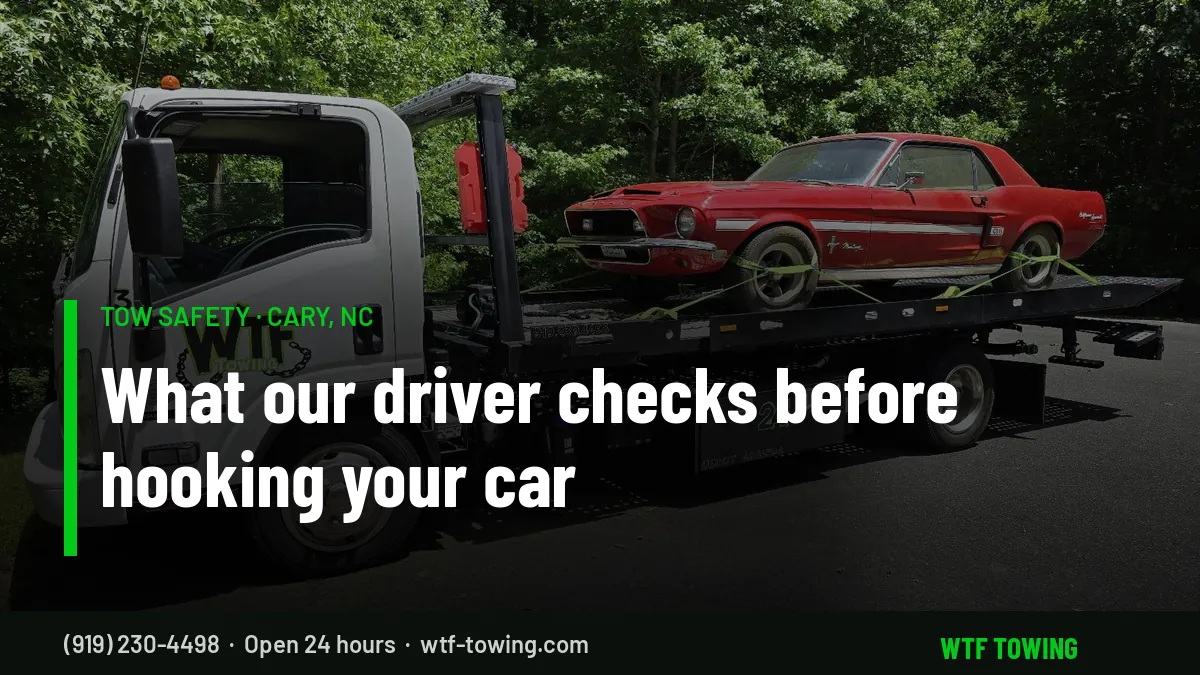
Once the car is on the bed or on the wheel-lift, it has to stay put through braking, turns and the bumps on Cary Parkway. On a rollback, that usually means securing the car at each corner, with straps over the tires or attached at proper tie-down points, plus the winch line holding the front.
Straps are checked for tension before the truck moves and again after the first short stretch of driving, since straps can settle as the suspension compresses. Straps should never run across brake lines, wheel spokes in a way that can bend them, or painted body panels.
Our photos of our tow trucks on the job show what a properly strapped car looks like on the bed.
Why we photograph everything, at pickup and at drop-off
Photos protect you and they protect us. At pickup, the driver photographs the car from all sides and close up on any existing damage. At drop-off, whether that is your driveway, the shop of your choice or a lot near RDU, the driver photographs it again.
Those two sets of photos settle the questions that otherwise turn into arguments: Was that scratch there before? Was the bumper already cracked from the accident? Did the wheel get curbed during loading? With time-stamped photos on both ends, the answer is right there.
That kind of accountability is part of why we point people to our customer reviews rather than asking them to take our word for it. It is also one of the checks we suggest in our post on how to tell a real local towing company from a call-center broker.
What you can do to help the tow go clean
You do not have to supervise the driver, but a few simple steps help:
- Tell the dispatcher what you drive. Year, make, model and whether it is AWD, 4WD, an EV or lowered. That sends the right truck the first time.
- Take your own photos. Walk around the car with your phone before it is hooked. Thirty seconds of video is plenty.
- Point out anything unusual. Aftermarket body kits, a low front splitter, a known oil leak, a wheel that will not turn, a tow eye in the trunk.
- Have the key ready. The driver may need to put the car in neutral, release the parking brake or unlock the steering.
- Look the car over at drop-off. Do a quick walk-around before the driver leaves, and speak up right away if something looks off.
What changes the work, and the price
A careful hookup does not always take the same effort. A few things add time or equipment, and they are worth knowing up front:
- Whether the car needs the rollback instead of the wheel-lift
- How low it sits and whether it needs boards or extra positioning to load
- Where it is: a flat lot, a steep driveway, a parking deck, a shoulder on I-40, or off the road entirely and needing a winch-out
- Whether it rolls, steers and shifts into neutral
- The distance to the drop-off and the time of day
Our post on what a cheap phone quote can leave out covers the questions to ask so the price you hear matches the job.
Frequently asked questions
Can a tow truck damage my car?
It can if the wrong truck is used, the car is hooked at the wrong points or it is loaded at a bad angle. A careful driver who checks drivetrain, clearance and hookup points first, and straps the car properly, prevents nearly all of it.
Is a flatbed safer than a wheel-lift?
For AWD vehicles, EVs, low cars and damaged cars, a flatbed (rollback) is the right choice because all four wheels are off the road. For many front-wheel-drive cars, a wheel-lift that picks the car up by its tires is safe and practical, especially in tight spaces.
What should I do if I find damage after a tow?
Point it out to the driver before they leave if you can, and take clear photos. Then compare against the pickup photos. With photos on both ends, it is quick to see whether the damage was there before.
When your car makes you say WTF, you call WTF Towing. We handle towing in Cary, NC and the surrounding towns around the clock, with a driver who looks before hooking. Call (919) 230-4498.
