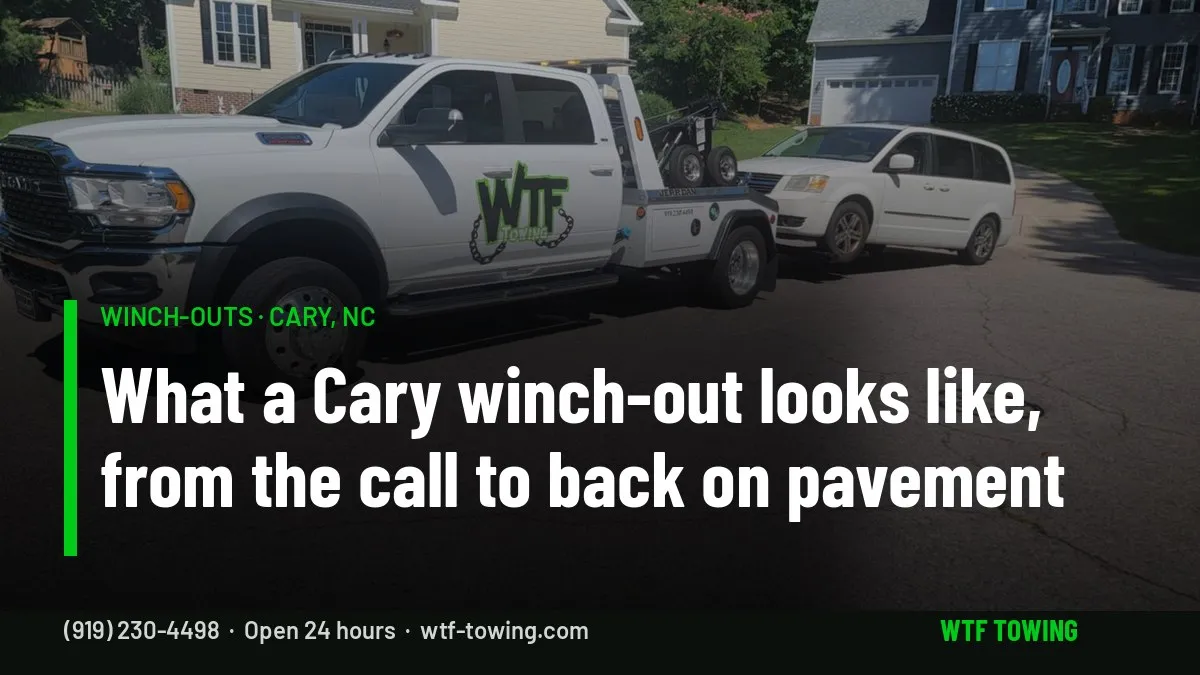
A winch-out in Cary, NC is a controlled pull that brings a stuck car out of mud, a ditch, a soft shoulder, or off a curb and back onto pavement without tearing up the car or the ground. It usually takes less time than most drivers spend spinning their tires first, and the fastest way to get one started is to call (919) 230-4498.
Here is what a typical Cary winch-out looks like from the phone call to the car rolling away. Our earlier post on what a winch-out service is and when to call for one covers the basics; this one is about the job itself.
Where Cary cars get stuck
Cary sits on Piedmont red clay, and wet clay is about as slick as anything you will ever drive on. After a hard rain, the grass shoulders along the two-lane roads on the south and west sides of town — Holly Springs Road, Penny Road, Ten-Ten Road, Green Level Church Road, Old US-1 out toward New Hill — turn soft, and a right-side tire that drops off the edge sinks instead of climbing back up. The ditches beside those roads, and along the country roads toward Holly Springs and Apex, are deeper than they look from the driver’s seat.
In town it looks different. A car jumps a curb on Cary Parkway or Kildaire Farm Road and ends up high-centered on the median. Someone misses the edge of a driveway and puts two wheels in a wet front yard. At Crossroads Plaza, Fenton, and Park West Village, tall curbs and parking blocks catch the undersides of low cars. On US-1, I-40, and NC-540, it is usually a car that slid off the shoulder into the grass; our post on breaking down on US-1 in Cary covers that side of it. When ice hits, all of it happens at once.
The call: what we ask, and what to have ready
Location first, and precise: the road plus the nearest cross street, or a dropped pin. Then how the car is sitting: which wheels are off the pavement, whether it is nose-down or high-centered, and what it is resting against. Tell us the vehicle and whether it is all-wheel drive, electric, lifted, or lowered, because that decides which truck comes. Tell us what the ground is, and whether the car will start and steer. If anyone is hurt or the car is blocking a lane, call 911 before you call us.
What you do while you wait matters. Stop trying to drive out. Every spin of the tires digs the hole deeper, packs wet clay into the tread until the tire is as smooth as a racing slick, and cooks the transmission or the clutch. Put it in park, set the brake, hazards on. On a road shoulder, get out on the side away from traffic and stand well back; in a yard or a lot, staying in the car is fine. And politely decline the neighbor with a pickup and a strap.
Which truck comes, and where it parks
Most Cary winch-outs are handled by our Ram 5500 wrecker. It carries a Jerr-Dan wheel-lift and a winch, so it can pull from the pavement while the car is off it, then lift the front or rear wheels and tow if the car cannot be driven. Our two Isuzu NRR rollbacks, with 21-foot Jerr-Dan beds, carry a winch at the head of the bed. They come when the car needs to ride on a flatbed after the recovery anyway: all-wheel drive, electric vehicles, anything with damage underneath, or a car that will not roll, and they winch the car straight up the bed in one motion. Our winch-out service page has more on the service itself.
Where the truck parks is the first decision the driver makes on scene. It stays on firm ground — pavement, packed gravel, a driveway — with its lights on, positioned so traffic from behind sees it before it sees you. A wrecker that follows the car into the mud is two stuck vehicles instead of one, so sometimes the right call is a longer line and a slower pull. On a road shoulder, North Carolina’s Move Over law tells drivers to move over or slow down for a tow truck with its amber lights on.
What the driver actually does
Walk-around first. The driver checks what the car is sitting on and what is under it: a differential resting on a curb, a control arm hooked on a root, a bumper cover pushed into the dirt. Then he finds the recovery point. Most cars have one: a fixed hook on trucks and many SUVs, or a threaded eye that screws into a covered hole in the bumper on many sedans and crossovers. Those points are built for a straight pull along the length of the car. If a factory point is not usable, he rigs to the frame or subframe with a rated strap and soft shackles — never to a suspension arm, an axle, a steering part, or the bumper cover.
Direction matters. A car nose-down in a ditch usually comes out backward from the rear recovery point, so the front end lifts instead of plowing. A car high-centered on a curb is lifted, not pulled: the wheel-lift picks it up off the obstacle and sets it down on its wheels. A car sunk in a yard may need a snatch block to change the angle and multiply the pull.
Then the setup: a line dampener over the cable, transmission in neutral, parking brake off, ignition on so the steering unlocks (an EV goes into its tow mode so the parking pawl releases). Everyone clears the area in line with the cable, including you. The pull is slow on purpose: low, steady tension, a few feet at a time, stop and look, pull again. If the car starts to swing, he stops and re-rigs rather than forcing it. Back on pavement, he does a second walk-around — tire sidewalls, anything hanging underneath, fluid on the ground, how the steering feels — and you decide together whether to drive it or ride to a shop on the truck.
A few cases change the plan. An all-wheel-drive car that cannot be driven afterward rides on the rollback, never on the wheel-lift. An EV carries its battery pack under the floor, so a high-center gets checked closely and the car goes on a flatbed if there is any doubt. Vans, box trucks, and machines stuck on job sites are medium-duty recoveries like the man lift we pulled out of gravel in Apex: same principles, heavier gear.
What drives the price of a Cary winch-out
We do not publish a flat number because two winch-outs on the same road can be very different jobs. What moves the price: how far the truck travels to reach you (we are based in the Morrisville–Cary area, so most of town is a short run); how far the car is from firm ground and how deep it is, since a tire dropped off the shoulder is a short job and a car sunk to the frame is not; the rigging required, whether a single straight pull, a snatch block, or a second truck; time on scene; the vehicle’s weight and drive type; and whether it needs a tow afterward. Many roadside plans cover a winch-out only when the car is within a short distance of a maintained road. Read yours before you assume.
Stuck right now? Do this
- Stop spinning the tires. Park, brake set, hazards on.
- On a road, get out on the side away from traffic and stand well back. If anyone is hurt or you are blocking a lane, call 911 first.
- Pin down where you are: road and cross street, an address, or a dropped pin.
- Note how the car is sitting, which wheels are off, and what the ground is.
- Call (919) 230-4498 with the vehicle, the drive type, and all of the above.
- Get the price and the ETA before the truck rolls.
- Decline the friendly pull from a passing pickup, and do not dig or jack on soft ground.
- When the truck arrives, stand where the driver asks and let him run the rigging.
Common questions
Can’t a friend with a pickup just pull me out?
Sometimes, and sometimes it breaks something expensive or hurts somebody. A strap looped over a hitch ball can shear the ball off and send it flying. A strap on a bumper or a control arm bends whatever it is hooked to. A hard yank on a high-centered car drags it across the obstacle instead of lifting it over. And the pickup often ends up stuck beside you.
Will winching damage my car?
Not when it is rigged to the right point and pulled straight and slow. Most of the damage we see happened before the truck arrived: spinning, driving forward onto whatever the car was hung on, or a friendly pull.
My car is stuck in my own yard in Cary. Is that a call you’ll take?
Yes. It is an everyday kind of call after a rain, usually a car that slid off the driveway edge into wet grass. The truck stays on the driveway or the street and runs a long line, so we do not add ruts of our own. In a neighbor’s yard or a business’s landscaping, let the owner know before we pull.
Stuck in Cary, Morrisville, Apex, or Holly Springs right now? Call (919) 230-4498. When your car makes you say WTF, you call WTF Towing.
