If your car just died on US-1 in Cary, do three things in this order: get it as far onto the right shoulder as it will roll, turn on your hazards, and stay belted in the car if traffic is moving fast beside you. Then call (919) 230-4498 — WTF Towing is based in the Cary–Morrisville area and runs US-1 around the clock, so the truck that comes is close, not dispatched from across the county.
US-1 through Cary is a freeway, not a street. Speeds are highway speeds, the shoulders vary from wide to almost nothing, and the interchanges at Walnut Street and Cary Parkway stay busy from the morning rush until late evening. A breakdown here isn’t like stalling in a shopping-center lot; the goal is to get you and the car out of there safely, fast. Here is exactly how to do that, and what happens once you call.
The first sixty seconds: get out of the travel lanes
The moment the engine stumbles, a tire lets go, or the dash lights up, signal right and start easing toward the shoulder while you still have momentum. A car that is coasting will roll a surprising distance; a car that is stopped in a live lane is the most dangerous thing on the road. Aim for the right shoulder, not the left — the left shoulder on US-1 is narrow, it sits against the median wall, and a tow truck can’t work there safely.
Once you’re stopped, hazards on, and put the car in park with the parking brake set. If you’ve made it to an exit ramp, a wide gravel shoulder, or a grassy area beyond the white line, even better: the farther you are from the fog line, the safer everyone is, including our driver.
If the car quit in a lane and will not move at all, stay belted, keep the hazards on, and call 911 before you call us. Law enforcement can protect the scene and get traffic moved around you; we’ll get there as soon as the road is safe to work.
Figure out where you are on US-1
The first thing we’ll ask is where you are, and “somewhere on US-1” costs time. US-1 through Cary carries the name Claude E. Pope Memorial Highway on the signs, and the exits give you the easiest landmarks:
- The I-40 / I-440 interchange at the Raleigh line — the north end of the Cary stretch.
- Exit 101 — Buck Jones Road / Walnut Street / Crossroads Boulevard, the busiest exit in town, next to the Crossroads shopping district.
- Exit 99 — Cary Parkway.
- Exit 98A — Tryon Road.
- Exit 98 — where US-64 splits off toward Apex and Pittsboro; south of here US-1 narrows and runs on toward Apex.
Tell us which direction you’re traveling (northbound toward Raleigh or southbound toward Apex), the last exit you passed, and what you can see — an overpass, a sign, a business. If you can, drop a pin in your phone’s map app and read us the coordinates, or share it by text. Any of these gets the truck to the right shoulder on the first pass instead of driving past you on the wrong side of the median.
Stay in the car, or get out?
There isn’t one answer, so here is how to decide. If the shoulder is narrow, traffic is heavy or fast, it’s dark, or it’s raining, stay in the car with your seat belt on. A belted person inside a stopped car with its hazards on is far better protected than a person standing beside it. This is doubly true at night — our guide to nighttime breakdowns covers why.
Get out only if you can get well away from traffic: over a guardrail, up an embankment, or across a wide grass strip. Exit on the passenger side, never the traffic side, and take kids and pets with you. Never stand behind the car, never stand between two vehicles, and don’t try to flag down other drivers. If the trunk is on the traffic side, leave whatever is in it — our driver will get it.
One more thing: North Carolina’s Move Over law requires drivers to change lanes or slow down for stopped tow trucks with their amber lights on. It protects our operator on your shoulder, and it’s the reason we ask every Cary driver to move over when they see one.
What to tell us when you call
You’ll talk to a person, not a menu. Have these ready and the call takes a couple of minutes:
- Where you are and which direction — see above.
- What you’re driving — year, make, model, and whether it’s all-wheel drive or electric. That decides which truck we send.
- What happened — won’t start, overheated, flat tire, a noise then nothing, a crash. Some of these don’t need a tow at all (more on that below).
- Where the car should go — home, your regular shop, a dealer in Cary or Raleigh, or a shop we trust if you don’t have one.
- How many people are with you, so the right truck comes.
You’ll get the price before the truck rolls, and the price you’re quoted is the price you pay. We take cash and cards. If you’d rather text your location than say it, that works too.
Which truck shows up, and why it matters
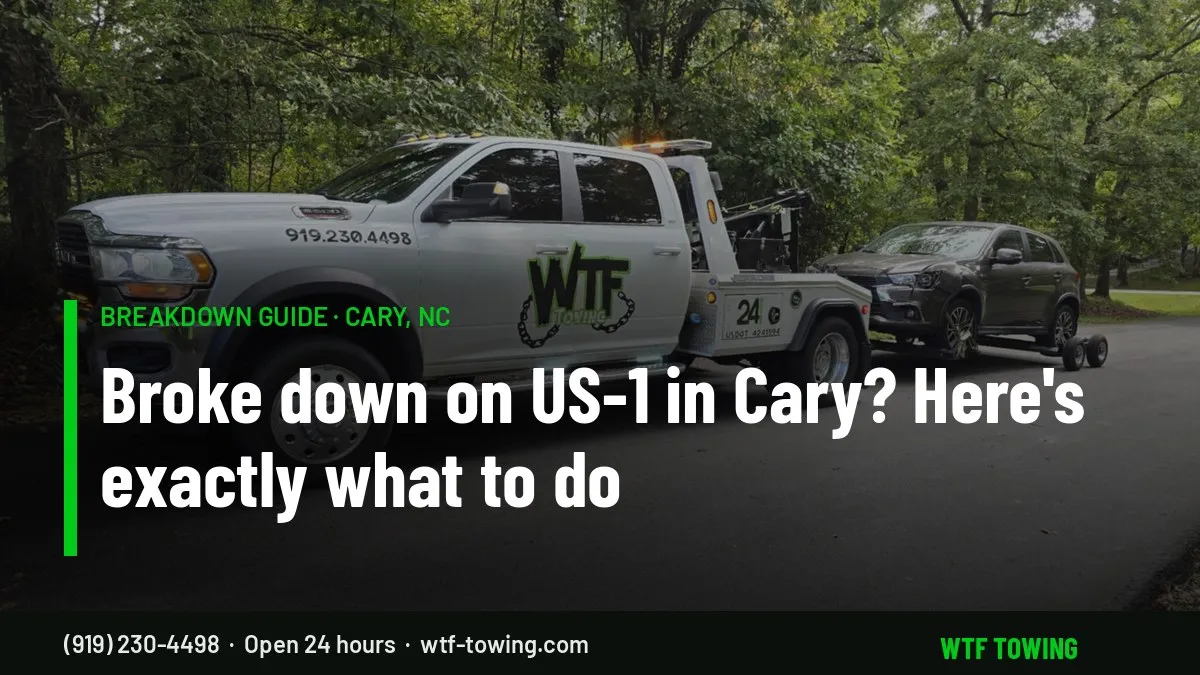
We run a Ram 5500 wrecker with a Jerr-Dan wheel-lift and two Isuzu NRR rollback carriers with 21-foot Jerr-Dan beds. The wheel-lift is the fast hookup for front- or rear-wheel-drive cars and light trucks on a shoulder — it picks up one end of the car and gets you moving in minutes, which is what you want when traffic is going by at highway speed.
The rollbacks are for anything that shouldn’t roll on its own wheels: all-wheel-drive vehicles, electric vehicles, lowered cars, and cars with crash damage or a wheel that’s no longer pointing the right way. The whole vehicle rides on the bed. If you tell us “AWD” or “EV” on the phone, a rollback comes the first time and nobody has to wait for a second truck. Our tow truck guide goes deeper on the difference.
What the driver actually does on the shoulder
Expect the truck to pull in behind you, angled out slightly with its lights running. That’s on purpose: the truck is a shield between traffic and the work. The driver will check on you first, look at the car, and tell you exactly what he’s about to do. Then he hooks up — wheel-lift under the drive wheels or the car winched up onto the bed — secures it with straps, and gets everyone off the shoulder. The paperwork happens in the cab or at the destination, not on the fog line. A highway shoulder is the most dangerous place in the whole job, so we don’t linger on it.
At the other end, the driver unloads where you’ve asked — in your driveway, in a shop’s lot, at a dealer’s service entrance — and, if it’s after hours, in a spot the shop can get to in the morning. Tows into Raleigh, Apex and the rest of the Triangle are routine runs for us.
It might not need a tow at all
A lot of US-1 “breakdowns” are fixed right there on the shoulder. A car that clicks but won’t crank usually needs a jump start, and we’ll tell you honestly whether the battery is done. A flat gets a roadside tire change if you have a spare, and a tow to a tire shop if you don’t. A gauge that was lower than you remembered gets fuel delivered, enough to reach a station. Two wheels off the pavement in the grass gets a winch-out. Tell us the symptoms, and we’ll send the fix instead of just a hook. The Labor Day post has a five-minute check that prevents most of these in the first place.
The US-1 breakdown checklist
- Signal right and coast to the right shoulder while you still have momentum.
- Hazards on, park, parking brake set.
- If you’re stuck in a lane and can’t move, stay belted and call 911 first.
- Decide: stay belted inside (narrow shoulder, fast traffic, dark, rain) or get well clear of traffic on the passenger side.
- Note your direction, the last exit you passed, and a landmark — or drop a pin.
- Call (919) 230-4498 with your vehicle, what happened, and where it should go.
- Get the price and the ETA before the truck rolls.
- Keep the hazards on until the truck is behind you, and let the driver run the hookup.
What decides the cost
We don’t publish a price list because every call is different, but the factors are simple, and we’ll tell you the number before we move. Distance is the biggest one: from the Walnut Street exit to a driveway in Cary is a short run; to a dealer across Raleigh is longer. Vehicle type matters — a big SUV or a van on a rollback is a different job than a compact car on the wheel-lift. Recovery work adds to it if the car is off the pavement and needs to be winched back to the road. Time of day and holidays don’t: there’s no holiday rate, and no surprise on the invoice.
Common questions
The police are here. Do I have to use the tow company they call?
If your car is blocking a lane or creating a hazard, law enforcement may call a wrecker from their own rotation to clear the road quickly. If you’re safely on the shoulder and not in the way, you can call the company you want. Call us — we’ll tell you honestly how soon we can be there.
Can you tow me to a shop in Raleigh or Apex?
Yes. Cary to anywhere in the Triangle is a normal run, and longer trips — Greensboro, Charlotte, the coast — are quoted the same upfront way through our long-distance towing service.
Will you really come at 3 a.m.?
Yes. We’re open 24 hours a day, 7 days a week, holidays included, and a person answers the phone.
Can I ride in the truck?
In most cases, yes — tell us how many people are with you when you call and we’ll make sure the truck that comes has the seats.
Broke down on US-1 right now? Call (919) 230-4498. When your car makes you say WTF, you call WTF Towing.
