The tow truck that shows up matters more than most people realize. Put an all-wheel-drive SUV on the wrong truck and you can damage the drivetrain; send a rollback to a tight Cary parking deck and it can’t get to the car. This guide explains the types of tow trucks, what “towing capacity” and “duty class” actually mean, which truck your vehicle needs, and what WTF Towing runs — so when you call (919) 230-4498, you know what’s coming and why.
The two jobs a tow truck does
Every tow truck does one of two things: it lifts one end of your vehicle and lets the other end roll (a wheel-lift or wrecker), or it carries the whole vehicle on a bed (a flatbed, also called a rollback or carrier). Everything else — light, medium, heavy duty; integrated; rotator — is a variation on those two ideas, scaled up for bigger loads.
Which one you need comes down to a simple question: can two of your wheels safely roll on the road for the length of the trip? For a front-wheel-drive sedan going three miles to a shop, yes. For an EV, an AWD vehicle, a car with a bent wheel, or anything going to Charlotte, no.
Wheel-lift wreckers
A wheel-lift truck slides a steel yoke under the front (or rear) tires, cradles them, and lifts that end of the car off the ground. The other two wheels roll. It’s fast — a hookup on a highway shoulder takes minutes, which matters when traffic is going by at 65 — and the truck itself is shorter and more maneuverable than a flatbed, so it fits in parking decks, apartment lots and narrow neighborhood streets where a 21-foot bed can’t turn around.
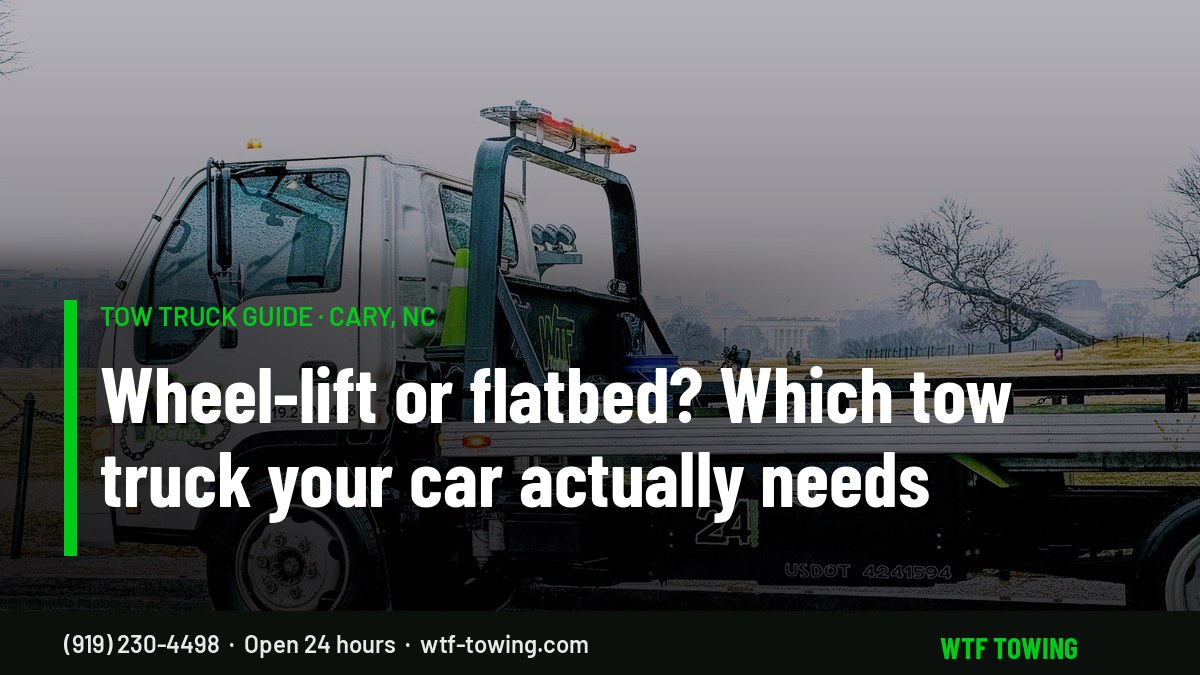
Best for: front- or rear-wheel-drive cars and light trucks with no drivetrain damage, short trips, tight spaces, and vehicles that need to be pulled out of a spot before they can be loaded onto anything. Our Ram 5500 wrecker with a Jerr-Dan wheel-lift handles most of these calls in Cary, and it’s also the truck that does winch-outs and recoveries.
Not for: all-wheel-drive and four-wheel-drive vehicles (unless the driveshaft is disconnected or dollies are used under the rolling wheels), electric vehicles, and long-distance runs.
Flatbed rollback carriers
A rollback tilts its bed to the ground, winches the vehicle up onto it, and carries it with all four wheels off the road. Nothing on your car turns, so nothing wears or breaks: no transmission spinning without lubrication, no EV motor generating current it isn’t designed to handle, no bent suspension part dragging.
Best for: AWD and 4WD vehicles, electric and hybrid vehicles, lowered or low-clearance cars, vehicles with crash damage or a wheel that no longer points straight, motorcycles (with the right straps), and any long-distance move. WTF Towing runs two Isuzu NRR rollbacks with 21-foot Jerr-Dan beds; they cover everything from a Tesla in an RTP garage to a long-distance tow to the coast.
The trade-off: a rollback needs room. It’s long, and it needs a straight run to lower the bed and load. In a packed deck or a dead-end cul-de-sac, the wheel-lift often has to pull the car to a spot where the rollback can reach it — which is why telling us where the car is sitting matters as much as what it is.
Duty classes: light, medium, heavy
“Light duty,” “medium duty” and “heavy duty” describe the size of vehicle a truck is built to handle, and they follow the same weight classes the trucking industry uses.
- Light duty covers passenger cars, SUVs, minivans and pickups — roughly anything rated under 10,000 pounds. This is most of the traffic in Cary and most of our calls.
- Medium duty covers box trucks, delivery vans, shuttle buses, small dump trucks and equipment — generally the 10,000-to-26,000-pound range. Our trucks are built on Class 5 chassis and handle medium-duty work in that range; tell us the vehicle and we’ll tell you straight whether it’s a fit.
- Heavy duty means tractor-trailers, loaded dump trucks, motor coaches and fire apparatus, which need a purpose-built heavy wrecker or a rotator. We don’t run heavy-duty rigs; if that’s what you need, we’ll say so on the phone rather than send the wrong truck.
“Towing capacity” is the number behind those classes: how much a given truck can safely lift and pull. Overloading a tow truck isn’t just illegal — it’s how brakes fade going down the hill on US-1 at Tryon Road. When you give us the year, make and model, the dispatcher is checking that match before the truck rolls.
Other trucks you’ll see on the road
Integrated wreckers combine the boom and wheel-lift into one heavy-duty unit for big recoveries. Rotators are heavy wreckers with a crane that rotates, used to right overturned trucks on I-40. Hook-and-chain trucks, the kind in old movies, are essentially gone from professional fleets because they damage bumpers and frames; if someone shows up with chains around your axle, send them away. And dollies — small wheeled cradles that go under a car’s rolling axle — let a wheel-lift move an AWD car in a pinch when a rollback can’t reach it.
Which truck your vehicle needs
- Front-wheel-drive car, drivable damage, short trip: wheel-lift. Fast and less expensive.
- Rear-wheel-drive car or truck: wheel-lift from the rear, or a rollback — depends on where it’s sitting.
- AWD, 4WD, Subaru, Audi Quattro, most modern SUVs: rollback. Say “all-wheel drive” on the phone and the right truck comes the first time.
- Tesla, Rivian, any EV or plug-in hybrid: rollback, always. Read why AWD vehicles need the right truck — the same logic applies to EVs.
- Lowered, sports or classic car: rollback, with the driver taking care on the bed angle.
- Crash damage, a wheel that’s pointing the wrong way, a leaking fluid: rollback.
- Stuck off the pavement: the wrecker first for the winch-out, then whichever truck the trip needs.
- Box truck, van, fleet vehicle, small equipment: medium duty — tell us the weight or the model.
- Anything going out of town: rollback.
What to tell us so the right truck comes
Year, make and model; whether it’s AWD, 4WD or electric; what happened (won’t start, flat, crash, stuck); exactly where it is, including “parking deck level 3” or “backed into a spot against a wall”; and where it’s going. That’s a two-minute call, and it’s the difference between one truck and two. You’ll get the price before we roll, and it’s the price you pay. Our post on what drives the cost of a tow explains how the truck type figures into the number.
Common questions
Does a flatbed cost more than a wheel-lift?
Sometimes, because it’s a bigger truck and a longer hookup — but if your vehicle needs a flatbed, a wheel-lift isn’t a cheaper option, it’s a damaged drivetrain. We’ll tell you which one your car needs and quote that.
Can you tow my AWD car if the rollback can’t reach it?
Usually. The wrecker pulls it to where the rollback can load, or uses dollies for a short move. Tell us the situation and we’ll plan it.
Do you tow motorcycles?
Yes, on the rollback with proper wheel chocks and soft straps. Tell us the bike when you call.
Do you handle semis or heavy equipment?
No — that’s heavy-duty work for a different kind of truck. We’ll tell you on the phone rather than waste your time.
Need the right truck right now? Call (919) 230-4498. When your car makes you say WTF, you call WTF Towing.
