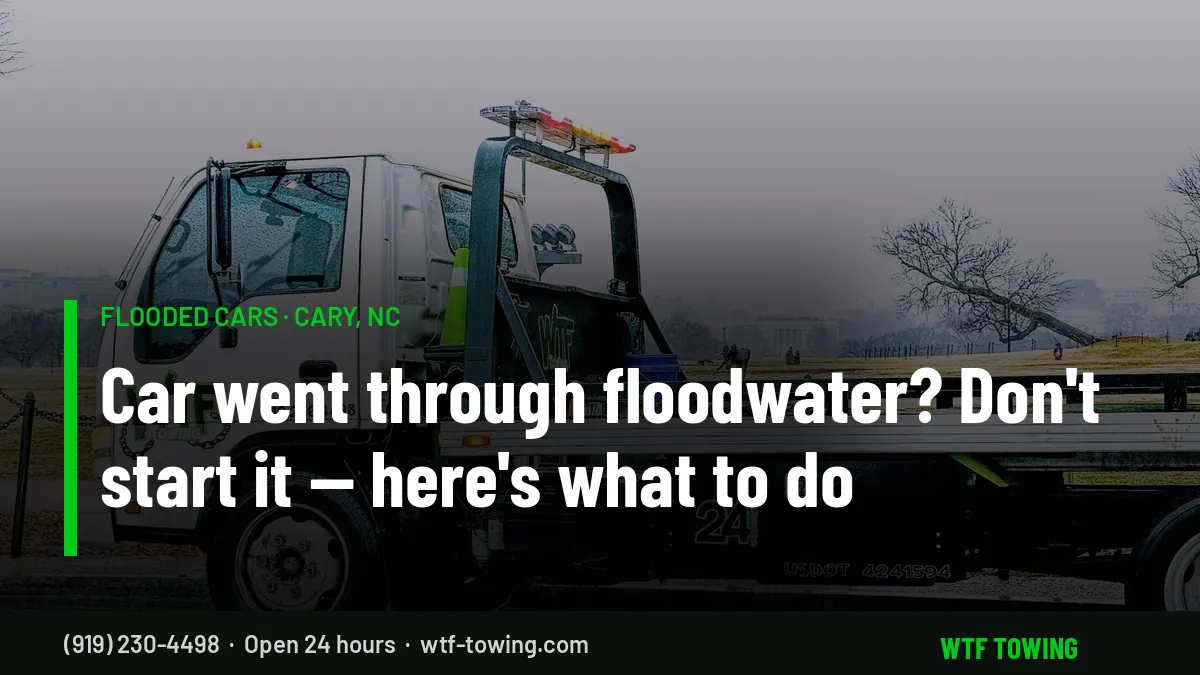
If your car has been in floodwater, do not try to start it. Leave it where it is, get yourself to dry, high ground, and call for a flatbed tow to the shop of your choice. Starting a flooded engine is the single most expensive mistake a driver can make after a storm, and it usually happens in the first five minutes.
The Triangle floods fast. A summer thunderstorm or the tail of a tropical system can dump inches of rain in an hour, and the low spots along Crabtree Creek, Walnut Creek and the smaller creeks that wind through Cary fill up before the storm drains can catch up. This guide covers where the water collects, why driving through it goes wrong, what to do if your car is already wet, and how a flooded car actually gets towed.
Where Cary-area roads flood
Flash flooding in Wake County follows the creeks. When the rain is heavy enough, the trouble spots are the places where a road dips down to cross a creek or runs alongside one.
- Crabtree Creek. The creek runs from the Cary and Morrisville side east through Raleigh, and the low ground around Crabtree Valley Mall and Glenwood Avenue is one of the best-known flood spots in the region. Parking lots there have flooded before, and cars parked in them have flooded with them.
- Walnut Creek. It starts near the Cary–Raleigh line and runs east across south Raleigh. Low crossings and lots near the creek can take water in a heavy storm.
- Cary’s own creek crossings. Swift Creek, Black Creek and their branches run under neighborhood streets and greenway crossings across town. Most of the time they are trickles. In a cloudburst they rise in minutes, and the dip in the road becomes a pond.
- Underpasses and highway ramps. Low points under bridges on US-1, I-40 and I-440 can hold water when drains clog with leaves and debris, especially in fall.
- Apartment and shopping-center lots. Big paved lots shed water to one corner. If your car is parked in that corner, it can sit in a foot of water while the rest of the lot looks fine.
If you are in Raleigh when it happens, our page on towing in Raleigh covers how we run jobs across the city.
Why you never drive through standing water
The National Weather Service slogan is “Turn Around, Don’t Drown,” and it exists because people badly misjudge water on a road. A few facts that are worth remembering:
- About six inches of water can reach the bottom of many cars, cause loss of control and stall the engine.
- About a foot of moving water can float many passenger cars.
- About two feet of moving water can sweep away most vehicles, including SUVs and pickups.
You cannot see the road under muddy water. It may be washed out. The current may be stronger than it looks. And the engine’s air intake on many cars sits low behind the bumper, so even water that does not look deep can get sucked straight into the engine.
The fix is simple and costs you ten minutes: turn around and find another route. In Cary there is almost always one.
Why you never start a flooded car
This is the part people get wrong. The water recedes, the car looks fine, and the natural move is to turn the key and see. Here is what can happen when you do:
- Hydrolock. If water got into the cylinders, the pistons try to compress it. Water does not compress. The result can be bent connecting rods and a ruined engine. An engine that might have been dried out becomes an engine that has to be replaced.
- Electrical damage. Modern cars are full of computers, sensors and connectors. Powering up a wet system can short modules that might have survived if they had been dried first.
- Contaminated fluids. Water can get into the oil, transmission fluid, fuel and brake fluid. Running the car circulates it.
- Hybrids and EVs. A flooded high-voltage battery is a hazard. Do not try to power it on, do not plug it in to charge, and do not park it in or next to a garage or house until it has been checked.
A flooded car needs to go to the shop on a truck, not under its own power. Let a technician check the oil, the intake and the electrical system before anyone turns the key.
How a flooded car gets towed
Most flooded cars ride on a rollback. A flooded car may not roll freely, its electronics may not let it shift to neutral, and AWD and 4×4 vehicles should not be towed with wheels on the ground. For those reasons we send one of our Isuzu NRR rollbacks with a 21-foot Jerr-Dan bed. You can read more about how that works on our flatbed towing page.
Here is what the driver actually does on a flood call:
- Waits for safe water. We do not drive a truck into moving floodwater, and we will not ask you to. If the car is still in water, the job starts once the water drops enough to work safely.
- Checks the ground. Flooded shoulders and lots go soft. The driver picks a spot for the truck that will hold it.
- Winches it out if needed. If the car is stuck in mud or sitting off the pavement, it gets pulled out with the winch first. That is a winch-out, and it is often part of a flood call.
- Loads it without starting it. The car is winched up the bed. Nobody turns the key.
- Straps it down and takes it to the shop, your home or wherever you choose.
What to do if your car has been in floodwater
- Get out and get to high ground if the water is rising. A car can be replaced. Call 911 if you or anyone else is trapped.
- Do not start the car. Do not try “just to see.” If the key is in, take it out.
- Do not jump-start it or charge it. This goes double for hybrids and EVs.
- Take photos of the car, the water line on the doors and inside the cabin, and the surroundings. The water line tells your insurance adjuster and your mechanic how high it got.
- Call your insurance claim line and ask what they need. Flood damage is usually handled under a policy’s comprehensive coverage, but your policy decides that, so ask.
- Call for a tow and tell the dispatcher the car was in water, how deep it got and whether it is still sitting in it.
- Decide where it goes: the shop of your choice, the dealer’s service department or home while you sort out the claim. Call the shop first; after a big storm, shops fill up.
- Get water out of the cabin once it is safe. Open doors and windows if you can, and pull out wet mats. Mold starts fast in a warm North Carolina car.
What to have ready when you call
- Exact location: road name, cross street or the lot and which corner the car is in.
- Year, make and model, and whether it is AWD, 4×4, hybrid or electric.
- How high the water got: tires, doors, dashboard.
- Whether the car is still in water or the water has gone down.
- Where you want it taken.
What affects the cost of a flood tow
We do not post prices because every flood call is different. The factors that move the price are the ones you would expect:
- Distance from pickup to drop-off.
- Whether a winch-out is needed to get the car back to solid ground before loading.
- Vehicle type and weight. A full-size pickup is a different job from a compact sedan.
- Time and conditions. Storm nights are busy, and wet, soft ground takes more time to work safely.
Ask for a quote when you call. We will tell you what the job involves before the truck rolls.
Frequently asked questions
Can I drive my car if the water only came up to the tires?
If the water never got above the bottom of the doors and the car started and ran normally before it was in water, it may be fine. But if there is any chance water reached the air intake or the floor, have it checked before you drive it. Getting it towed costs less than replacing an engine.
Should I try to dry the engine myself?
No. Checking for water in the cylinders, oil and fuel takes tools and a lift. Leave it to the shop.
Can you tow a flooded electric car?
Yes, on a flatbed, without powering it up. Tell us it is an EV when you call. After towing, keep it outdoors and away from buildings until it has been inspected.
Will you come out during the storm?
We run 24 hours a day, including storm nights. We will not drive into moving water, but we will get to you as soon as it is safe and get the car out once the water allows it.
Flood calls tend to come in bunches, so save the number now. If you need towing in Cary, NC after a storm, or a tow truck near you in Cary, we are licensed and insured with $1,000,000 in liability coverage (USDOT 4241594). For more on how the seasons hit Triangle cars, see why fall is peak tow season in Cary and how a Triangle summer breaks cars down.
When your car makes you say WTF, you call WTF Towing: (919) 230-4498.
