
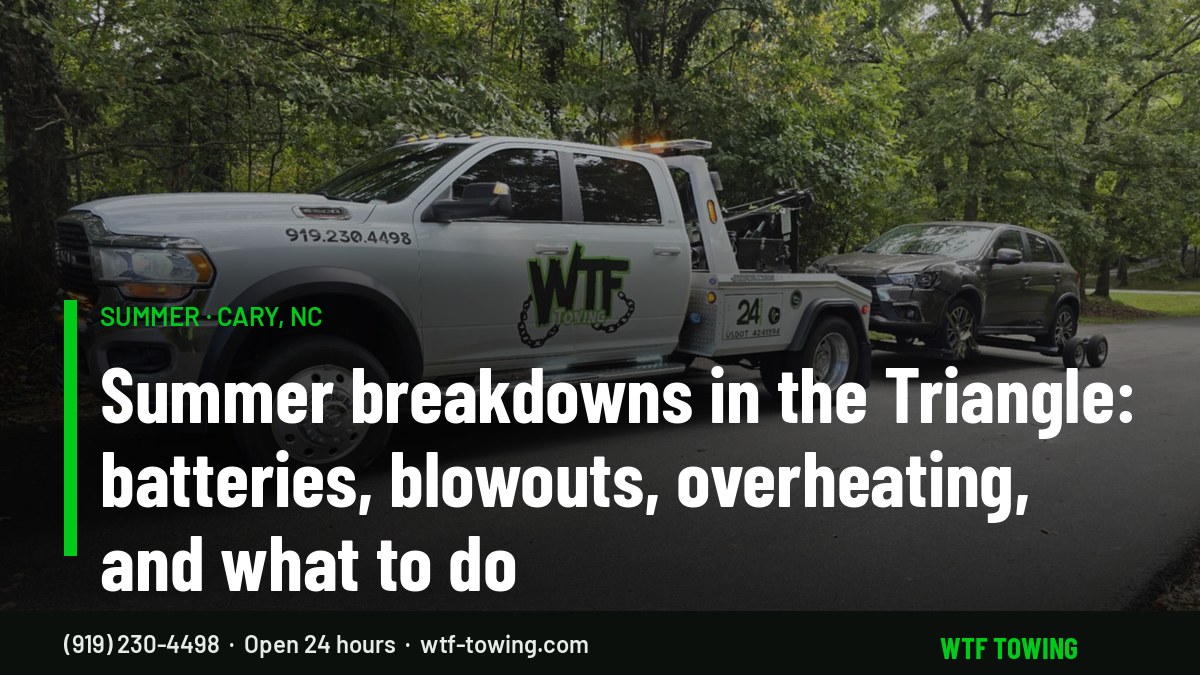
Summer is when Triangle cars fail in the most predictable ways: batteries cooked by weeks of 90-degree days, tires blown on hot pavement, engines overheating in the I-40 crawl to the beach. WTF Towing runs 24/7 through all of it — July 4th weekend included, no holiday rate — and most of what we see in summer is preventable. Here’s what heat does to a car, the check that prevents the common calls, and what to do when it happens anyway: call (919) 230-4498.
What heat does to a car
- Batteries die in summer, not winter. Everyone blames the cold, but heat does the damage: it speeds up the chemical wear inside the battery and evaporates the fluid. A battery weakened by July fails in the first cold snap — or in the RDU parking lot in August. If yours is four-plus years old, get it tested now.
- Tires. Pressure rises as they heat up, and an under-inflated tire flexes and builds heat until the sidewall lets go. Blowouts at speed on US-1 and I-40 are a summer specialty. Check pressure cold, in the morning, to the door-sticker number, and look at the tread and the sidewalls.
- Cooling systems. Idling in traffic with the AC on full is the hardest thing you can ask of a cooling system. A marginal radiator, a weak fan or a small leak that was invisible in April shows up as a temperature gauge climbing on the Beltline in July.
- Everything rubber and plastic. Belts, hoses and wiper blades age fast in the heat. A belt that snaps takes the water pump and the alternator with it — which is why a “belt squeal” in June is a tow in July.
The summer check
- Battery tested; terminals clean and tight.
- Tire pressure set cold, all five tires, and the tread checked — a bald tire on a wet road in a summer thunderstorm hydroplanes.
- Coolant level in the overflow tank; a look under the car for pink or green drips.
- Belts: cracked, glazed or squealing means replace.
- AC blowing cold — not for comfort, for the fact that a failing AC compressor can seize a belt.
- In the car: water, a charger, a sunshade, and our number saved.
Summer storms and flooded roads
Afternoon thunderstorms drop an inch of rain in twenty minutes and the low spots fill: the dips on Kildaire Farm Road and Maynard Road, underpasses, the low ends of parking lots. Never drive into water you can’t see the bottom of — a foot of moving water moves a car, and a few inches into the intake ruins an engine. If your car has been through water and stalled, don’t restart it; that’s a tow to a shop, and restarting is what turns a drying-out into a replacement. Wet roads after a dry spell are also slick with oil for the first half hour; that’s when the winch-out calls come in from the grass along NC-55 and Cary Parkway.
Road trips and the airport
The beach traffic on I-40 east and US-64 toward the Outer Banks means long stretches at highway speed with a full car and the AC on — the exact conditions that expose weak batteries, tires and cooling systems. If it happens far from home, we do long-distance towing on the rollback, quoted upfront, from wherever you are back to Cary or on to your shop. Flying out of RDU? A car that sits in a hot lot for two weeks comes back with a battery that may not crank; call from the gate and we’ll meet you at the car. The RDU page explains how that works.
If you overheat on the highway
- Turn the AC off and the heater on full — it pulls heat out of the engine. Yes, in July.
- Signal right and get to the shoulder while you still have momentum. Hazards on.
- Shut the engine off. Don’t open the radiator cap; the system is under pressure and it will scald you.
- Stay belted in the car if traffic is heavy; get well clear on the passenger side if you can.
- Call (919) 230-4498. If it’s a small leak and the engine cooled, we’ll say so; if the gauge pinned, it’s a tow, and driving it “to the next exit” is what turns a hose into a head gasket.
Common questions
Do you work July 4th and Labor Day?
Yes — 24 hours, every day, no holiday rate. Our Labor Day post has the holiday-weekend version of this checklist.
My car died in the RDU lot. Can you get in?
Yes. Tell us the lot and the row; we jump-start and tow from the airport lots and decks constantly.
The temperature gauge went up and came back down. Am I fine?
Not necessarily — that’s often a small leak or a failing fan that will do it again in traffic. Get it looked at before the beach trip, not on it.
Overheated, blown out or stranded in the heat? Call (919) 230-4498. When your car makes you say WTF, you call WTF Towing.
