A winch-out is what you need when your vehicle is off the pavement and can’t get itself back: two wheels in the mud on a soft shoulder, a car nosed into a drainage ditch off Green Level Church Road, an SUV high-centered on a curb in a Crossroads parking lot, a pickup that slid off a gravel drive in the rain. A tow truck backs up to a safe spot, runs a cable to your vehicle, and pulls it back onto solid ground under control — and most of the time you drive away afterward. If that’s you right now, call (919) 230-4498; WTF Towing runs winch-outs across Cary, Morrisville, Apex and the rest of the Triangle 24 hours a day.
This guide covers what a winch-out actually is, how to tell whether you need one, why trying it yourself usually makes it worse, and what to do while the truck is on its way. For a walk-through of a recovery from the driver’s side — where the truck parks, how the cable is rigged, how long it takes — read our job spotlight on a Cary winch-out.
What a winch-out service is (and isn’t)
A winch is a powered drum of steel cable or synthetic rope mounted on the tow truck. The operator anchors the truck, runs the cable to a proper recovery point on your vehicle, and lets the winch do the pulling — slowly, in a straight line, with the truck’s weight holding everything steady. It is a recovery, not a tow: the goal is to put your vehicle back on a surface it can drive on, and if it’s undamaged, you’re done.
It is not the same as a tow. A tow moves your vehicle somewhere else on the truck. A winch-out puts it back where it can move itself. The two often go together — a car that went into a ditch hard enough to bend something gets winched out and then loaded — but a plain stuck-in-the-grass call is usually winch-out only, which is quicker and costs less.
It is also not something a friend’s pickup and a tow strap can safely replace. More on that below.
How to know you need one
Any of these means stop trying and make the call:
- Your wheels spin and the vehicle doesn’t move. Every second of spinning digs the tire deeper and polishes the surface under it. In Cary’s red clay after a rain, two attempts can turn a “just off the edge” into axle-deep.
- The vehicle is tilted or the ground is soft on one side. Shoulders along NC-55, Tryon Road and the rural stretches toward New Hill drop off fast. A vehicle leaning toward the low side can roll if you keep working it.
- A wheel is off the pavement over a curb, a drainage edge or a parking-lot island. The frame or the underbody is likely resting on something; driving it off can tear a bumper, a splash shield or an oil pan.
- You’re in a ditch, a culvert or standing water. Don’t restart the engine if water reached the intake; get out on the high side and call.
- It’s an all-wheel-drive vehicle, an EV, or a lowered car. These have less clearance and more expensive parts underneath. Being pulled the wrong way costs more than the recovery.
If the vehicle is simply on the shoulder and drivable — a flat, a dead battery, out of fuel — you don’t need a winch-out, you need the right roadside service. Our services page lays out what’s what, and we’ll tell you honestly on the phone.
Why the “buddy with a truck” method goes wrong
Every driver in Wake County knows someone with a pickup and a strap, and every tow operator has seen how that ends. The problems are physics, not skill:
- Wrong attachment point. Modern cars have specific recovery points; the tie-down loops, suspension arms and bumper brackets people usually hook to are not them. Pulling on a control arm bends it. Pulling on a bumper removes it.
- Shock loading. A truck taking a running start at a slack strap puts a jolt through both vehicles measured in tons. That’s how hitch balls turn into projectiles and why straps snap.
- Wrong angle. Pulling sideways out of a ditch drags the tires against the bank and loads the suspension the way it was never designed for. A winch pulls straight, and the operator repositions the truck to make that possible.
- No control. Once a strap starts moving a car, nobody can stop it gently. A winch moves an inch at a time and stops the instant the operator lets off.
A winch-out done right costs less than a bent tie rod, and a lot less than a torn-off bumper on a leased car.
What the truck actually does
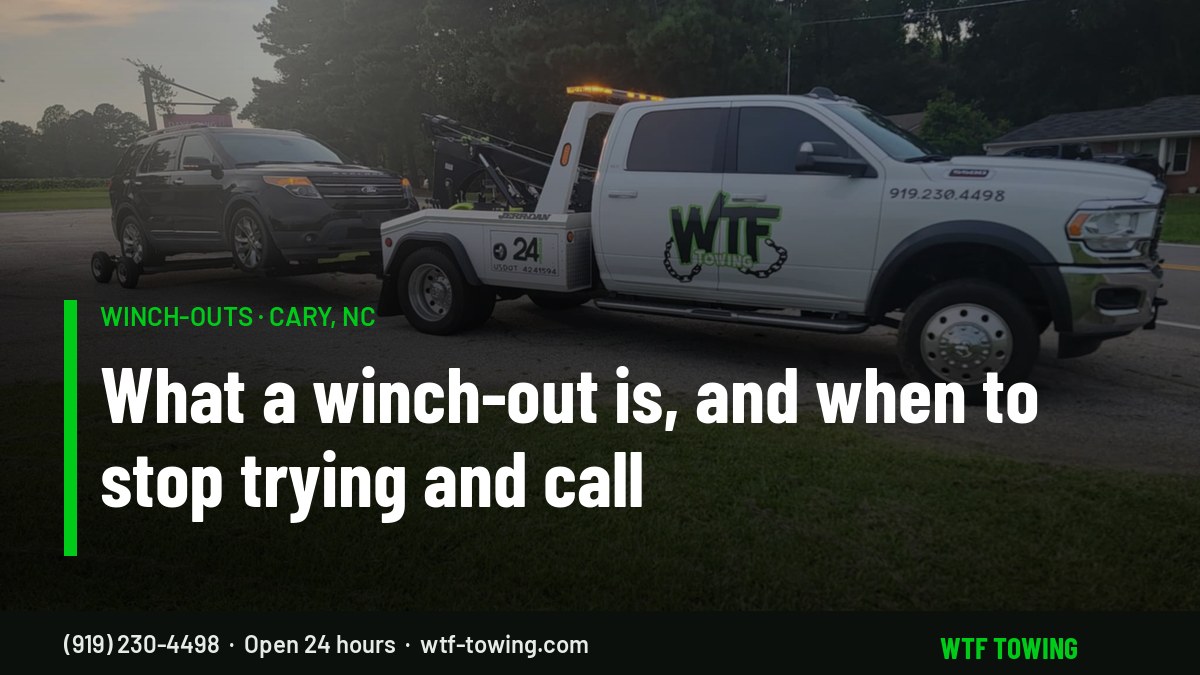
Our Ram 5500 wrecker handles most Cary winch-outs. The operator parks it on firm ground in line with the direction your vehicle needs to travel, sets the brakes and, where needed, drops the outriggers. He checks under your vehicle for the correct recovery point, rigs a soft shackle or a hook to it, and puts a damper on the line. Then he winches slowly, watching the vehicle, stopping to reposition if anything binds. Once you’re on pavement, he looks the vehicle over — tires, underbody, fluids — before you drive off. If something is bent or leaking, the rollback comes and we tow you to a shop instead.
The job spotlight shows this step by step, including where the truck parks in a tight neighborhood street and what happens when the first pull doesn’t free the car.
What to do while you wait
- Stop trying to drive out. Put it in park, set the brake, hazards on.
- If you’re on a road shoulder, stay belted inside unless you can get well clear of traffic on the passenger side. On a private lot or a driveway, get out on the uphill side.
- Call (919) 230-4498. Tell us where you are (a cross street, a business name, or a dropped pin), what you’re driving, and how it’s sitting — “front wheels in the ditch, leaning left” tells us which truck to send.
- Get the price. We quote it before the truck rolls, and the number covers the recovery; if a tow turns out to be needed too, you’ll hear that before it happens, not on the invoice.
- Have your keys ready and the vehicle unlocked so the operator can put it in neutral and steer during the pull.
- Don’t let anyone stand near the cable. If it lets go, it lets go fast.
Where Cary drivers get stuck most
The same spots come up over and over: soft shoulders along NC-55 and Green Level Church Road after rain; the grass strips beside Cary Parkway and Kildaire Farm Road where a car goes wide on a turn; parking-lot islands and curbs at Crossroads, Waverly Place and Park West Village; steep, wet driveways in Preston, MacGregor Downs and Lochmere; and the gravel drives and construction sites out toward New Hill and Apex, which is where equipment ends up needing the heavier recovery work. Ice on the bridges over I-40 and US-1 adds a winter batch every year.
What decides the price
We don’t publish a rate card because no two recoveries are identical, but the factors are simple and we’ll tell you the number before we move. How far the vehicle has to be pulled and how much resistance there is (dry grass versus deep mud); whether the operator needs to reposition or rig twice; the size of the vehicle; and whether a tow is needed afterward. Time of day and holidays don’t change it. What drives the price of a tow in Cary covers the same logic for towing.
Common questions
Can I drive the car after a winch-out?
Usually. The operator checks tires, underbody and fluids before you go. If a wheel is out of line or something is leaking, we’ll tell you and can tow it from there.
Will the winch damage my car?
Not when it’s rigged to the right recovery point and pulled straight, which is the whole point of having an operator do it. The damage people worry about almost always comes from the attempts made before we arrive.
Do you winch out AWD and electric vehicles?
Yes. They need the same careful straight pull, and if they need to be moved afterward, it’s on the flatbed rollback, never dragged on their wheels.
How fast can you get to me?
We’re based in the Cary–Morrisville area and we’ll give you an honest ETA on the phone, not a number designed to keep you from calling someone else. Cary, Morrisville, Apex, Holly Springs, RTP and RDU are all short runs; Raleigh and Durham are normal ones.
Stuck right now? Call (919) 230-4498. When your car makes you say WTF, you call WTF Towing.
