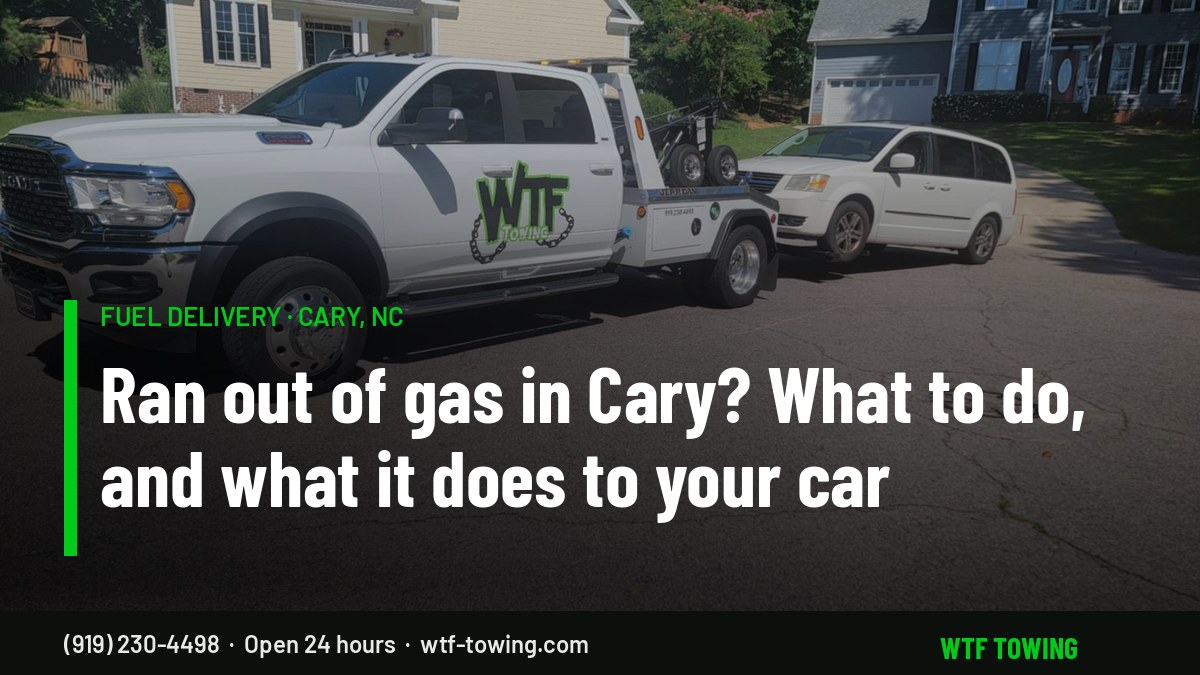
If you’ve just run out of gas in Cary, the fix is simple: get the car onto the shoulder or into a lot, hazards on, and call (919) 230-4498. WTF Towing brings enough fuel to get you to a station, 24 hours a day, anywhere in Cary and the Triangle, and the price is quoted before the truck rolls. No tow, no gas can walk along the highway, no waiting on a friend.
This post covers the part nobody explains until it happens to them: how a car actually behaves when the tank runs dry, why it happens so often on the same Cary roads, what it can do to your vehicle, what to do in the first minute, and how fuel delivery works. If you just want the service details, they’re on the fuel delivery page.
How you know it’s fuel, not something else
Running dry rarely happens all at once. First the engine stumbles under load — climbing the ramp onto I-40, accelerating out of a light on Cary Parkway — then it smooths out on level ground for a minute, then it stumbles again. That surge-and-recover pattern is the fuel pump sucking air as the last gallon sloshes around the tank. Finally the engine quits, the power steering gets heavy and the brake pedal gets firm, because both use engine power.
A dead battery or alternator feels different: the dash dims, warning lights come on, the engine doesn’t stumble first. A clogged filter or a failing pump can mimic running dry, but if your gauge has been on E and the low-fuel light has been on for a while, trust the obvious answer. When you call, tell us what you saw and we’ll bring the fix that matches — fuel, a jump start, or a truck if it’s neither.
Why “E” lies to you
Most drivers know their car will go a while after the light comes on — and that’s exactly how people end up on the shoulder of US-1. The reserve after the low-fuel warning varies by vehicle, and it shrinks in ways you don’t notice: the gauge float reads differently on a hill, in stop-and-go traffic the engine burns more per mile than the “range” estimate assumes, and the trip computer’s miles-to-empty is a guess based on your last few miles, not the next few. Idling in the Southpoint or Crossroads parking deck, running the AC in July, or crawling on I-40 at rush hour all eat the reserve faster than the number on the dash.
The habit that prevents nearly every fuel-delivery call: treat a quarter tank as empty. It’s also better for the car (see below).
What running dry does to your car
It’s not just an inconvenience. Your fuel pump sits inside the tank and uses the gasoline around it to stay cool. Running the tank down to nothing lets it run hot and dry, and repeated low-fuel driving is one of the common reasons pumps fail early — a repair that costs many times what a tank of gas does. The last fuel in the tank also carries the sediment and water that settle to the bottom, which is why a car that ran dry sometimes runs rough for a few minutes after it’s refueled.
Diesels are worse. Run a diesel dry and the fuel system fills with air; many need to be bled or primed before they’ll restart, and some modern trucks won’t start on fuel alone. If you drive a diesel pickup or a work van, tell us on the phone so the driver knows what he’s walking into.
Electric vehicles can’t be refueled on the shoulder at all. If your EV runs out of charge on NC-540 or US-64, that’s a flatbed tow to the nearest charger or home — never a wheel-lift, and never towing an EV on its wheels.
The first minute: what to do
- At the first stumble, signal right and start moving toward the shoulder or the nearest exit while you still have momentum. A coasting car goes farther than you think; a stopped car in a live lane is the most dangerous place on the road.
- Get as far right as you can, park, parking brake on, hazards on.
- If you’re on a highway — US-1, I-40, I-440, NC-540 — stay belted in the car unless you can get well clear of traffic on the passenger side. On a surface street or in a lot, pull into the nearest driveway or parking space.
- Note where you are: the last exit, a cross street, a business name, or drop a pin.
- Call (919) 230-4498. Tell us the vehicle, gas or diesel, and where you are. You’ll get the price and an honest ETA before we roll.
- Don’t walk the highway with a gas can. The shoulder of US-1 at night is no place to be on foot, and most cars don’t start cleanly on a splash of fuel anyway.
Where Cary drivers run out
The calls cluster in predictable places. NC-540 (the Triangle Expressway) has long stretches between exits and, being a toll road, no gas stations on it — people gamble on making it to Davis Drive or NC-55 and don’t. US-1 between the US-64 split and the I-40/I-440 interchange is the same story at 65 mph. I-40 through the RTP stretch and the airport exits catches travelers who planned to fill up “after the flight.” And plenty of calls come from ordinary places: the Crossroads and Waverly Place lots, apartment complexes off Kildaire Farm Road, a cul-de-sac in Preston where somebody meant to stop on the way home. Our Cary page has the full list of neighborhoods and roads we cover, and the RDU page covers the airport lots specifically.
How fuel delivery actually works
The driver brings fuel in a proper container — regular gas or diesel, whichever you told us — and puts in enough to get you to a station comfortably, not a full tank. He’ll wait for you to start the car; if it stumbles for a few seconds while the pump re-primes, that’s normal. If it won’t start, he checks the obvious things (battery, the diesel priming issue above) and tells you straight whether it needs a tow instead. Cash and cards are fine, and the price you were quoted is the price you pay.
What decides the price: how far the driver runs to reach you, the fuel itself, and the time of day doesn’t — there’s no night rate and no holiday rate. Our post on what drives the cost of a tow explains the same logic for towing.
Common questions
How much fuel do you bring?
Enough to reach a station with margin — usually a couple of gallons. It’s meant to get you moving, not to replace a fill-up.
Do you deliver diesel?
Yes. Tell us on the phone; diesels sometimes need priming after running dry and the driver plans for it.
My car won’t start even after the fuel went in. Now what?
Give it a few tries with a pause between — the pump has to move fuel up to the engine again. If it still won’t catch, the driver checks the battery and, if needed, we tow you to a shop. You’ll hear the price before that happens.
I ran out on NC-540 — can you get to me on the toll road?
Yes. Tell us your direction of travel and the last exit you passed, and stay in the car; the shoulders on 540 are narrow and the traffic is fast.
Out of gas right now? Call (919) 230-4498. When your car makes you say WTF, you call WTF Towing.
